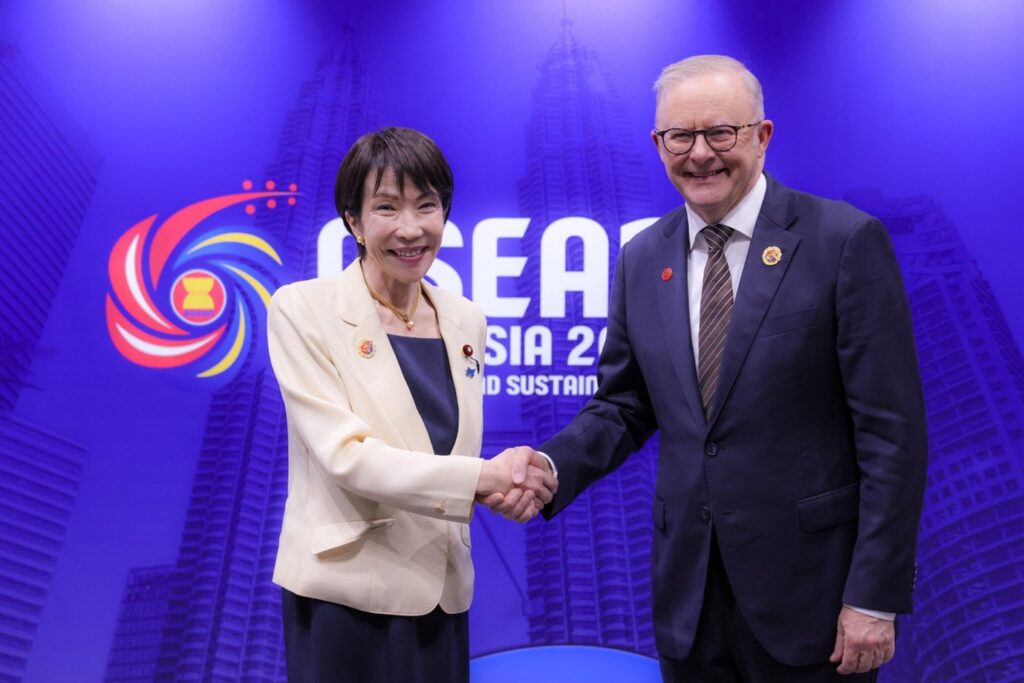
The ‘joint statement on energy security’, the signed partnership between Australia and Japan as answer to both advanced capitalist states growing economic instability amidst the ongoing war on Iran, reveals more than a cobbled together response to the global fuel shortage.
What is clear is that the war has exposed one of capitalism’s key contradictions, between the system’s need for global, interconnected markets on one hand, and the restrictive redundant form of individual nation-states on the other. A simple supply point disruption has exposed the fragility of such a globally interdependent economic system. The larger and more connected the capitalist system becomes, the more prone to world shaking events it finds itself – this is quite a damning weakness. Marx and Engels anticipated such a world we find ourselves within today:
“(Capitalism is)… a power which has become more and more enormous and, in the last instance, turns out to be the world market.” – The German Ideology
The Strait of Hormuz serves as an essential artery to the world economy. Around one-fifth of the world’s oil trade and a critical portion of liquefied natural gas (LNG) exports pass through this channel. The war has accelerated a fundamental shift in the reordering of the world, and the United States has demonstrated it is no longer the all powerful imperialist force it once was.
For the capitalist class in the west, in particular, this has the potential to be catastrophic. For workers, it is another sober reminder that this economic system that enshrines profit at the expense of human need, will always remain incapable of providing stability for all workers of the world.
Few advanced capitalist countries are as vulnerable to energy disruptions as Japan. The Japanese economy depends heavily upon imported oil, gas, and raw materials. For decades, the country has relied on stable maritime trade routes and access to these Middle Eastern energy supplies to sustain itself. The imperialist war on Iran has rudely exposed this dependence. Oil imports into Japan from the Middle East have fallen dramatically, forcing Japan’s ruling class to seek alternative suppliers.
Australia has emerged as one of the most important, both in terms of Australia’s supplies and regional proximity. “The effective closure of the Strait of Hormuz has been inflicting enormous impact on the Indo-Pacific,” Prime Minister Takaichi said at her visit to Canberra in May. An accurate statement, as the International Energy Agency put the amount of oil consumption the region needs at roughly eighty percent prior to the Strait’s closure. Takaichi’s statement was echoed by Albanese.
The Japanese bourgeoisie increasingly views energy security as inseparable from military and strategic policy. In the current epoch of growing inter-imperialist tensions between the US and China, this helps explain Japan’s continued rearmament, steered by Prime Minister Takaichi, and its closer move for ‘defence’ integration with the United States and Australia.
Japanese officials have increasingly looked to Australian LNG exports as a means of reducing their exposure to disruptions in the Persian Gulf. This has accelerated a trend already underway: the transformation of the Australian and Japanese relationship from a primarily economic partnership into a strategic alliance encompassing energy and military alignment. Most recently, in April Australian Defence Minister Richard Marles, and Japanese Defence Minister Koizumi Shinjirō formally signed off on a staggering 6.5 billion dollar (AUD) warship deal between Australia and Japan, with the latter state contracting Mitsubishi Heavy Industries to manufacture the first of a series of war frigates for the Australian Defence Force (ADF).
These policies reflect the growing fears of the Australian and Japanese ruling class of not only higher fuel costs, but strategic and political vulnerability. The capitalism of today requires continuous flows of energy, manufacturing, and commodities. The slightest interruption spells an unacceptable risk to profits, to industrial production, and (of primary importance) to social stability. For two countries heavily dependent on imported energy, refined or otherwise, the risk of prolonged disruptions raises the prospect of economic and political turmoil.
Australia occupies a peculiar position within the crisis. The country is one of the world’s largest exporters of LNG and possesses vast energy resources. The Australian ruling class sits fat and gorged on the profit made on exports of Australia’s natural resources. Yet on the other side of the coin, a stark inequality exists for Australian workers who experience soaring fuel prices, knock-on growing electricity costs, and an anxiety about a fast dwindling future for a relatively stable standard of living.
Over the last couple of decades successive governments – both Coalition (Howard, Abbott) and Labor (Gillard) – allowed much of Australia’s domestic refining capacity to be dismantled in pursuit of greater profitability and integration into global markets. Refined fuels could be imported more cheaply, and capital could be concentrated in export-oriented industries. As long as global trade functioned smoothly, this arrangement, for the most part, remained profitable. But the Iran conflict has exposed its fragility, as solid as a house of cards. Australia now imports a large proportion of its refined fuel despite being such a major energy exporter.
The result, when examined for utility, is absurd but entirely logical from the standpoint of capitalism. Australia exports enormous quantities of energy while Australian workers face rising costs and an increasing likelihood of global food shortages. Rising costs are ultimately passed on to working class households already struggling under years of stagnant wages and grotesque living expenses. Both the Australian and Japanese capitalist media describe an “energy security challenge”. While correct, this ignores the underlying reality that it is a crisis produced by the irrational organisation (or rather lack of organisation) of production under capitalism.
At the heart of it – this fuel crisis demonstrates a broader trend: the re-emergence and tendency towards imperialist competition following the 2008 financial crisis. Many bourgeois commentators proclaimed the arrival of an era of stable globalisation. International trade, the resounding argument proclaimed, would reduce conflict and bind nations together through mutual economic interests. Reality has blown this paper-thin veneer asunder with a few Iranian ballistic missiles and drones. Globalisation did not abolish the contradictions of capitalism. It merely internationalised them.
Today’s world economy is more interconnected than ever before, yet proportionally as fragile. A conflict in the Middle East can leave petrol stations dry in Bangkok, and Nissan factories shutdown in Tokyo. Nowhere is immune; not in this global capitalist system. The Australian and Japanese energy partnership reflects this reality. Both ruling classes are seeking to insulate themselves from the instability of the world market. Yet their efforts can only intensify broader imperialist rivalries.
As countries compete for secure access to energy, shipping routes, and raw materials, economic competition increasingly acquires a military dimension. Energy security becomes national security. Trade routes become strategic assets. Economic questions become questions of military power; of which big capitalists will dominate the earth.
This tendency can already be seen in the expansion of military cooperation between Australia, Japan, and the United States, as well as in growing tensions throughout the Indo-Pacific region. From the outside, these developments seem as accidents or mistakes of bourgeois politicians. The truth is this is the natural militaristic aspect of capitalist imperialism itself.
As Lenin explained, monopoly capitalism inevitably generates competition between states and capitalist cartels. The world is carved up between the dominant powers. The struggle for markets, resources, and of economic stability, of unimpeded growth and domestic social cohesion leads to the struggle between those competing powers. This current energy crisis is therefore not merely an economic phenomenon. It is also an expression of the growing instability of the imperialist world order.
While governments and corporations discuss supply chains and strategic reserves, we ordinary workers are left to bear the costs. Australian workers, as all workers across the world, face higher fuel prices, increased transport costs, and renewed inflationary pressures. Meanwhile Japanese workers confront similar pressures as rising energy costs flow through the economy. Despite the Japanese government’s attempt at artificially curbing inflation with its emergency funding. Japan is on track for a 3% rise towards the end of the year. As is always the case, the burden of the crisis will not be distributed equally.
Energy corporations, shipping companies, and major resource exporters are positioned to generate enormous profits from higher prices and increased demand. Meanwhile, workers face declining living standards and pressure to accept wage restraint in the name of national economic stability. The ruling classes in both countries have already attempted to present the crisis as a national problem invoking either national unity rhetoric, as seen in Albanese’s address to the nation “… we will deal with these challenges the Australian way.” Or through using the crisis to push a nationalistic re-industrialisation effort, reflected in Takaichi’s political strategy of Japanese rearmament and a ‘healthy’ Japanese industry. It is important to emphasise to workers of both states – reject these nationalistic tendencies! Australian workers do not share common interests with LNG corporations. Japanese workers do not share common interests with energy conglomerates or warmongers.
The fundamental divide is not between nations but between classes. The profits generated from Australia’s energy exports are overwhelmingly concentrated in the hands of major corporations and investors. Yet when crises emerge, governments expect workers to shoulder the burden.
If disruptions in the Middle East continue, inflationary pressures are likely to deepen. Capitalist governments may intervene more aggressively in energy markets, while businesses seek to pass rising costs onto consumers. The crisis may also accelerate imperialist efforts to reorganise global supply. However, these adjustments will require substantial investment and will never succeed in eliminating the underlying conditions, the inherent contradictions that are immutable under capitalism, despite the ruling class’ best attempts.
Most worrying is the possibility that this energy insecurity will contribute to further militarisation and rearmament. As we have seen, Australia, Japan and the rest of AUKUS are already deepening their strategic cooperation. This is only likely to become worse. Future bourgeois governments may use the language of energy security to justify increased nationalism, military spending and greater participation in regional imperialist conflict.
What can only be guaranteed under this system is growing economic hardship and the risk of imperialist conflict. The silver lining is that crisis births revolutionary conditions and gives rise to periods of intensified class struggle. We are witnessing it in real time. Worsening conditions have already emitted strikes, protests, and political discontent in many countries. A prolonged energy crisis is likely to sharpen these tendencies. History demonstrates that periods of economic disruption produce political radicalisation, and the working class begins to question institutions that are inherently incapable of providing stability and security.
Despite unprecedented technological development and productive capacity, capitalist society will forever remain vulnerable to the chaos it emanates. We cannot expect it to do anything beyond its limitations, and thus we must move to a society beyond it. Australia and Japan both possess vast energy resources, yet hundreds of millions are relegated to oppression and survival. Global productive capacity is enormous, yet a single crisis can threaten supply chains everywhere.
The world without conflict and economic turmoil begins with a world socialist revolution, and the reorganising of the whole of society into democratic public ownership of the world working class. Workers in Australia, in Japan, in Iran, and every other country share a common interest in ending this system that generates endless crises, and wars.
It is up to us to organise for this future!