
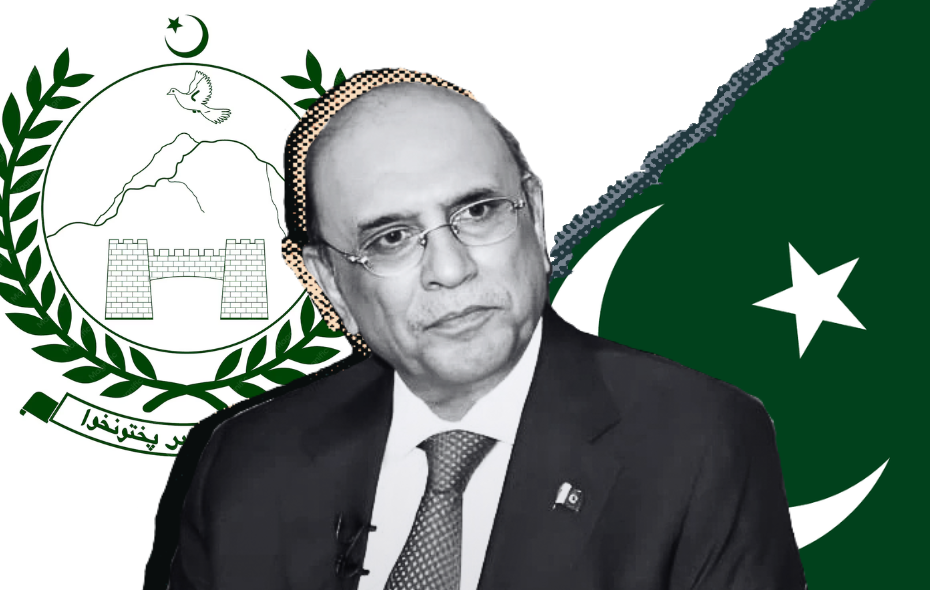
The Pakistani ruling class has once again used the threat of terrorism to justify an attack on democratic rights. But behind the emergency in Khyber Pakhtunkhwa lies a much deeper crisis of the state, its political parties and the capitalist system itself.
On 11 October 2026, Pakistan’s federal government imposed emergency rule and Governor’s Rule in Khyber Pakhtunkhwa (KP), removing the elected provincial government from power. The decision was subsequently approved by parliament on 14 and 15 October. The government justified the move by pointing to the growing number of terrorist attacks and accusing the Pakistan Tehreek-e-Insaf (PTI) provincial administration of failing to cooperate with federal authorities.
However, the removal of an elected government and the transfer of its powers to an appointed governor cannot be understood simply as a counterterrorism measure. It represents another serious attack on democratic rights and exposes the fragile character of parliamentary democracy in Pakistan, where the military establishment continues to exercise decisive influence over political life.
Under the new arrangements, the powers of the chief minister and provincial cabinet have been transferred to the governor, assisted by an unelected advisory council. Twelve districts, including areas of the former Federally Administered Tribal Areas (FATA), have also been placed under a separate administrative structure, with the military deployed under Article 245 of the Constitution.
For the people of these regions, who have already endured decades of military operations, displacement and repression, this is a return to the very policies that have repeatedly failed them.
Terrorism and the hypocrisy of the Pakistani state
There is no doubt that terrorism has become a serious threat in Khyber Pakhtunkhwa. Thousands of civilians, workers and lower-ranking security personnel have lost their lives. Yet the Pakistani establishment cannot escape responsibility for the conditions that produced this crisis.
The roots of religious militancy in the region go back decades. During the Cold War, the Pakistani state, working alongside American imperialism and Saudi Arabia, supported and armed Islamist groups fighting in Afghanistan. Under General Zia-ul-Haq, this policy became a central pillar of Pakistan’s regional strategy.
The consequences were devastating. Religious extremism, weapons trafficking and militant organisations became deeply embedded in the region. Even after the American invasion of Afghanistan in 2001, sections of the Pakistani establishment continued to distinguish between supposedly “good” and “bad” Taliban, supporting some groups while fighting others.
The return of the Taliban to power in Afghanistan in 2021 further exposed the contradictions of this policy. What sections of Pakistan’s ruling class initially celebrated as a strategic victory has contributed to renewed instability and conflict. Successive military operations, including Zarb-e-Azb and Radd-ul-Fasaad, have failed to eliminate terrorism. Instead, millions have experienced displacement, destroyed livelihoods, military checkpoints and the loss of basic democratic rights.
The question is simple: if two decades of military operations have failed to defeat terrorism, how will replacing an elected provincial government with an appointed governor solve the problem?
The emergency threatens to strengthen the same repressive approach that has already failed.
PTI offers no genuine alternative
Opposing Governor’s Rule does not mean defending the political record of Imran Khan or PTI. During its thirteen years in power in Khyber Pakhtunkhwa, PTI implemented policies that placed increasing pressure on ordinary people. Its administration pursued privatisation, changes to public healthcare and attacks on workers’ rights, while failing to address unemployment, poverty and the deterioration of public services.
PTI was also involved in negotiations with the Tehreek-e-Taliban Pakistan (TTP), including controversial proposals for the return and resettlement of militants. These policies were pursued alongside sections of the military establishment.
Despite its anti-establishment rhetoric, PTI has never offered a serious alternative to the capitalist system or the power of the military. Its politics remain centred on Imran Khan rather than an independent programme for the working class.
The limited organised resistance following the imposition of Governor’s Rule also exposes the weakness of this populist approach. Large rallies and fiery speeches cannot replace a movement rooted in workplaces, universities and working-class communities.
The Pakistan Muslim League-Nawaz and Pakistan Peoples Party are no different in their fundamental class interests. Both have repeatedly cooperated with the military establishment and defended policies that benefit the wealthy at the expense of workers and the poor.
The struggle between these parties is not a struggle between capitalism and an alternative system. It is largely a struggle between competing sections of the same ruling class.
The resistance of the Pashtun masses
The people of Khyber Pakhtunkhwa have repeatedly demonstrated that they are unwilling to accept either terrorism or state repression.
Movements such as the Pashtun Tahafuz Movement and Olasi Pasoon emerged from the experiences of ordinary people who had suffered through military operations, forced displacement, enforced disappearances and militant violence. These movements have challenged the official narrative that greater military intervention automatically brings peace. They have also shown the potential for independent mass mobilisation outside the traditional political parties.
Similar developments can be seen elsewhere in Pakistan, including the struggles of the Baloch Yakjehti Committee, the Awami Action Committee in Gilgit-Baltistan and mass movements in Pakistan-administered Kashmir.
Although these movements have different immediate demands, they reflect a common reality:
growing sections of the population no longer trust the traditional political parties or the institutions of the state to defend their interests.
The ruling class attempts to divide these struggles along ethnic, regional and religious lines. But the interests of Pashtun, Punjabi, Baloch, Sindhi and other working people are fundamentally the same. They all face exploitation, unemployment, rising living costs and increasingly authoritarian state policies.
The need for a revolutionary alternative
The Revolutionary Communists oppose the imposition of emergency rule, the removal of elected governments and the militarisation of civilian life. We also reject the reactionary violence of the Taliban and other fundamentalist organisations. However, genuine peace cannot be achieved through military operations, administrative changes or agreements between rival sections of the ruling class.
The fight against terrorism must be connected to the struggle against poverty, unemployment, privatisation, national oppression and the exploitation of the working class. Workers, students and local communities must organise independently through democratic committees capable of defending their rights and resisting both fundamentalist violence and state repression.
Above all, these struggles must be united across Pakistan through an independent revolutionary party with a clear socialist programme.
The history of Khyber Pakhtunkhwa demonstrates that neither military rule nor bourgeois parliamentary politics can provide lasting peace and security. The capitalist system continues to reproduce the very conditions of poverty, oppression and instability in which reactionary forces thrive.
The working class has no interest in defending one faction of the ruling elite against another. Its task is to build its own political alternative, unite the oppressed and fight for a socialist society in which the enormous wealth and resources of the region are used to meet human needs rather than the interests of generals, landlords and capitalists.
The choice facing the workers and oppressed masses of Pakistan is ultimately the same choice facing humanity as a whole: socialism or barbarism.