
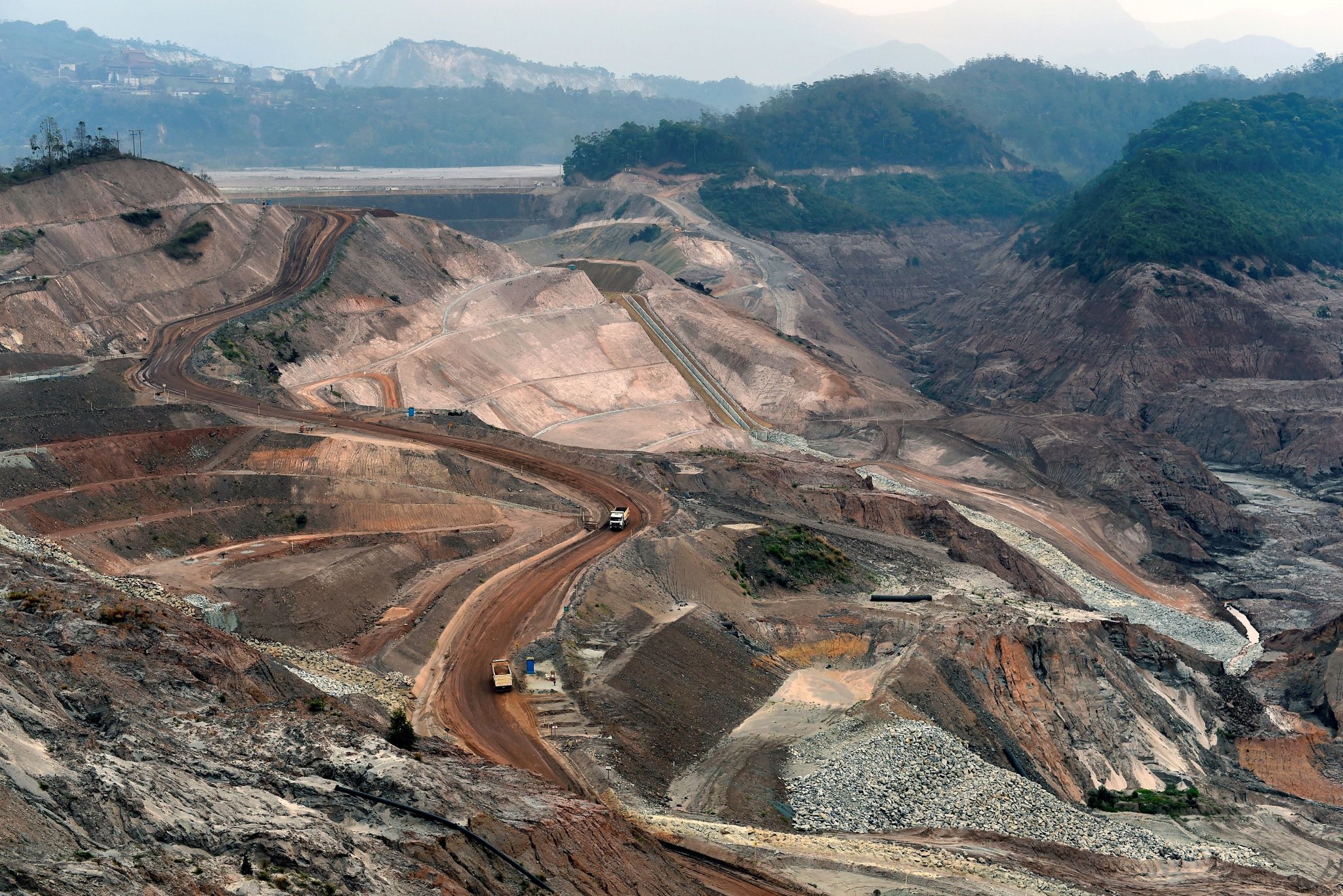
There are over two-thousand mining companies in Australia, with more than a thousand in Western Australia alone. The most prominent being Rio Tinto, BHP, and Fortescue Metals. Under this capitalist system, the exorbitant profits line the pockets of the capitalists that own these companies. Instead of using the astonishing wealth of these companies to resolve the problems facing workers and youth, social issues such as poverty, unemployment and the mental health crisis continue to plague society.
Rio Tinto has sullied the earth across 34 countries. In Australia, they extract and produce iron ore, salt, bauxite, alumina and aluminium and invest in copper and scandium projects. Whilst they claim they responsibly close and rehabilitate mining sites, this is a laughable statement, considering the widespread anger that has erupted within the public many times against the reality of the mining corporation’s environmental impact and harm they cause against local communities and their own workers.
Gina Rinehart, owner of Hancock Prospecting, meanwhile, holds investments in companies such as Arafura Rare Earths with the company’s prime focus being iron ore, lithium, oil and gas, potash, copper and rare earths. In 1993, Hancock Prospecting acquired Roy Hill, Australia’s largest iron ore mine, which exported a staggering 64 million tonnes of the material in just 2024 alone! Gina Rinehart is also a vocal and financial supporter of rising right-populist party One Nation and its leader Pauline Hanson, and an avid supporter of President Donald Trump, having attended his Mar-a-Lago and many other White House parties. Her (personal) net worth is $25.5 billion.

BHP, through Port Hedland, exported 290 million tonnes of iron ore in the last financial year, and had a market capitalisation of $333.24 billion as of June 18th 2026. A perfect example of ‘greenwashing’ in the mining industry would be BHP, who were revealed by leaked documents to have publicly celebrated their supposed plans to massively cut their emissions and invest in green energy, whilst internally agreeing never to do so. It is without a doubt that the same tactics have been applied by countless other mining companies. It is no wonder that mining bosses ignore or even deny climate change, despite the fact that the climate emergency has never been more severe for Australian workers and youth. These magnates profit directly from the fossil fuel industry and live in their own box, insulated from the brutal conditions the people are suffering under. No effective legislation can challenge their power, because the government exists to protect their private-property rights to the detriment of us workers.
In fact, the mining industry has such sway that the Western Australian government had to enact emergency powers on the 1st of April to access information that was being withheld by six major oil companies that they would not supply the government despite the crisis. The companies in question were Viva Energy (which services Shell stations), Ampol, Chevron, Downstream (which services Caltex stations), United, Mobil (which services 7/11 stations) and BP. The information in question is the source of which oil is obtained during the fuel crisis we are facing here in Australia. This comically came two hours before Anthony Albanese’s “Stay calm” message was broadcasted across the country, to attempt to downplay the fuel crisis and its devastating effect on the country.
An affront to history and culture
Horror stories are often shared in the media of mining accidents, the desecration of sacred land, and the insidious greed of mining companies.
This has included American mining company Alcoa cutting down acres of the Jarrah Forest in WA, FMG going ahead with mining operations without custodian consent, and Rio Tinto blowing up more sacred land despite their promise to the custodians to avoid the site.
When mining companies are challenged by those that suffer from their actions, their response is either to overwhelm the complainant in legal battles, pay a fine (which is more akin to pocket change for the big mining companies), simply bribe the custodians, or use divisive schemes to get what they want.
One example of the latter is the case of Andrew Forrest, founder and chairman of Fortescue Metals. Forrest has recently been fighting a legal battle for the right to mine the land of the Yindjibarndi people and their native title corporate (Yindjibarndi Aboriginal Corporation / YAC). YAC is demanding compensation for the land that Fortescue has been ravaging for iron ore since 2013 without the claimants’ permission. To clarify, this is land that has long been sacred to the Yindjibarndi and contains ancient rock art and archaeological evidence of human occupation dating back not just for a couple thousand years, but 50,000 years.
The Yindjibarndi people, who had been dispossessed (that is, massacred and enslaved) by the British from 1860, only got their land rights in 2017, despite having lodged the claim in 2003. This was 11 years after the high court abolished ‘terra nullius’, establishing that indigenous people had prior rights to the land.
Not only did Andrew Forrest not wait for the claim to be settled, but after starting the mining operations, he continued to push back against the council of elders and began secretly organising a group of Yindjibarndi, who formed the Wirlu-Murra Yindjibarndi Aboriginal Corporation. Forrest attempted to use this group to bypass YAC’s land claim and allow Fortescue to legally mine the land. The new claimants would receive $4 million a year in royalties from Fortescue, which again amounts to pocket change for the billion-dollar mining company.
This scheme fell through when it was judged that the only claimants who had land-use rights and the ability to give consent was YAC. Of course, as mentioned above, this did not stop Andrew Forrest from mining the land anyway.
Rapacious mining
Another frequent occurrence within the mining industry is not only its desecration of sacred cultural sites, but its wanton destruction of forestry and ecosystems critical to native species. On top of this, it is not only wildlife being slaughtered but workers too- all for the sake of billionaires’ profit.
Of course, mining companies are all too happy to make promises of a greener future, until it becomes an obstacle to profit, at which point their blatantly empty promises are put on full display.
As of recently, American mining company Alcoa has been under fire for unlawfully clearing protected Jarrah Forest in Western Australia for their bauxite mining operations between 2019-2025. This is the natural habitat of black cockatoos, an endangered species. They have been fined $55 million, with the money going towards invasive species management and conserving the remaining environment- but similar to the fines given to other mining companies and magnates, this is just pocket change.
Despite the active harm Alcoa has done in destroying the environment and further endangering native animals, the WA government has promised continuing operations to Alcoa until 2045 as part of a deal, which allows the government to ‘assess Alcoa’s environmental impact’ but has continued to allow Alcoa to clear land whilst this assessment takes place – which will be midway through 2027.
The mining company has cleared 28,000 hectares of Jarrah forest (known as djarraly in Noongar language), the only one existing in the world, with many of the trees being greater than 200 years old, and having a completely unique environment to anywhere else in the world with 80% of the 8,000+ species being endemic to the region and the region itself being evolved to withstand and reproduce after raging fires. A truly ancient forest that is tens of thousands of years old.
Despite the great significance of the forest’s health, with continued mining of the land predicted to end up with a majority of the forest destroyed by 2060, the WA government chooses to profit off of the mining deal with Alcoa. Workers are hardly safer than the land that’s being decimated. It’s well-known the hazards of laborious occupations – the highest death rates being those in transport, construction and agriculture, farming & fishing. The mining industry has its own bloody track record of workplace horrors – many of which are easily preventable if the aim of profit maximisation at the expense of workers did not factor in.
A significant portion of deaths and injuries in these industries are due to profit-cuts, subpar training, outdated or broken equipment, and from workers being forced to toil in poor conditions such as heavy rains and high winds.
In Western Australia, 2023-2024, Work Safety report found that there had been 942 reported injuries. Workplace environments, especially FIFO (fly-in, fly-out) have also had a significant surge of sexual assault and workplace harassment cases with mental health issues on the rise.
A growing conscience?
A spirit of disdain has begun to grow. The 11th of June marked the work-stoppage vote that 90% of Australian Manufacturing Workers Union (AMWU) backed. This followed after roughly seven months of failed negotiations between the union organisers and BHP regarding a new employment agreement, with workers growing more and more frustrated at being ignored and the agreement not being reached.
Western Australian Chamber of Minerals and Energy chief executive Aaron Morey claimed that these strikes would ‘damage the national economy’ and, likely echoing the thoughts of many among the bourgeois, stated “Militant unions must be pulled into line.”
With work stoppages potentially costing BHP $110 million to $126 million per day, and export disruptions potentially costing the WA government $6.85 million a day from royalties, this could be one of the biggest strikes in the Pilbara since 2008 where 11 out of 12 Rio Tinto train drivers did not show up to work because of the company’s inaction in reaching an agreement with their union – albeit the strike had little effect on Rio Tinto.
Strikes and protests, as actions of workers militancy, are not sufficient enough in the face of these billion-dollar corporations and their soulless owners – the billionaire class. When their source of wealth is seriously threatened, they will respond in the legal methods that enshrine their class dominance – that is through the brutal suppression by the police. In the case of reforms and working class wins, we celebrate them for they are hard fought and benefit the people insofar as is acceptable to the preservation of the capitalist economy. But this is the point – they are not sustainable. For a genuine, permanent solution we need revolution. We need an organised, revolutionary vanguard when that time comes.
With a nationalised mining industry, it will be the workers that will democratically decide the calls on operations, and instead of petty infighting between magnates over land resources, industry shall broker with Indigenous custodians and dictate what rate of production is actually needed of each resource and refinery. Workers’ health will take absolute priority with no cheap cuts to equipment, machinery or amenities. This is a future we can achieve, and it is a future that we must win.