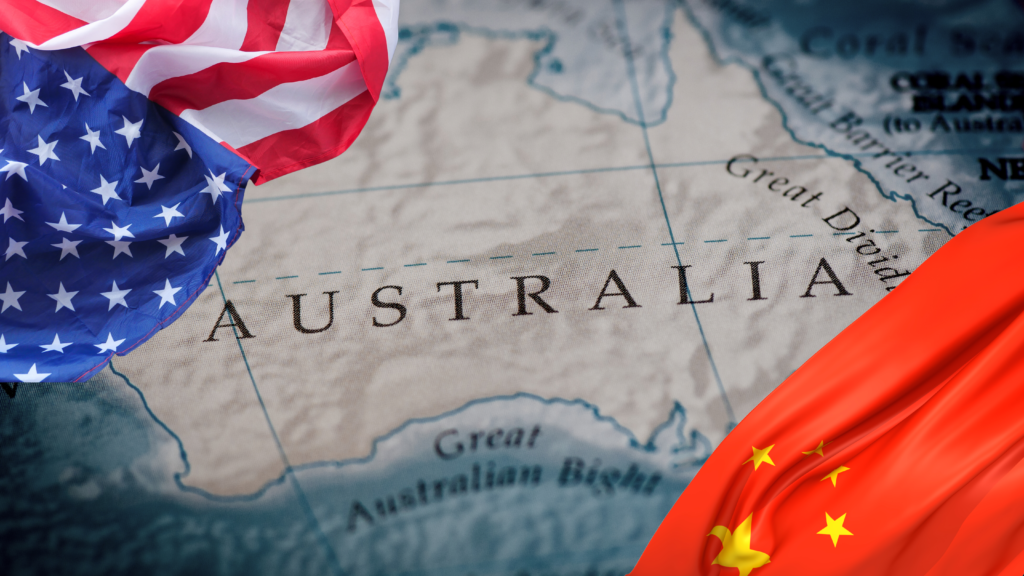
Australia has become a flashpoint in the intensifying rivalry between the United States and China. For Australia’s ruling class, balancing these two powers grows increasingly complex. The nature of the bourgeoisie, since its inception, is marked by short-sightedness, speculation, and a consistent loyalty to whichever imperialist power dominates.
China remains Australia’s largest trading partner, while the U.S. is its longstanding security ally. However, shifting global dynamics have slowly pulled Australia closer to economic dependency on China. The re-election of Donald Trump has further strained ties with Washington. His erratic negotiation tactics and protectionist tariffs have unsettled Canberra, prompting a more cautious diplomatic approach. In 2025, 68 per cent of Australians expressed pessimism about Trump’s second term -a sentiment reflected in the federal election, where the Liberal National Party suffered a humiliating defeat after mimicking Trump-style, anti-immigration policies.
Meanwhile, distrust toward China remains entrenched. Only 1 in 5 Australians trust Beijing’s foreign policy -a reaction reinforced by recent Chinese naval drills near Australia and New Zealand, followed by a continent-circling show of force. Australia now finds itself economically tied to a nation increasingly at odds with its key military ally.
Though not the core of its economy, Australia’s raw materials sector dominates its exports. In 2023, it exported $89 billion in iron ore, $67 billion in coal, $48 billion in natural gas, and $18 billion in gold. These resources sustain economic stability and underpin China’s Belt and Road Initiative—making Australia vital to both Chinese interests and its own capitalist class. Political elites exploit public belief in the importance of resource exports to justify ongoing environmental destruction, often downplaying the climate crisis in favor of short-term profit.
At the same time, 63 per cent of Australia’s GDP comes from the service sector -a flimsy foundation built on speculation and financial swindling. Exports to China, once 35 per cent of total trade, are declining amid a steel slowdown, but China still accounts for triple the volume of Australia’s next biggest export market. In 2024, two-way trade with China totaled over a quarter of Australia’s entire trade volume -nearly three times that of the U.S. This dependency continues to push Canberra to seek new markets to ease fiscal pressures.
Despite ongoing tensions, Beijing continues courting Australia, promoting a “united front” of free traders against U.S. protectionism. Yet this economic charm offensive contradicts their earlier military posturing.
Australia has maintained a trade surplus with China for nearly two decades -$197 billion USD in two-way trade in 2024. Based on Trump’s logic, this should have spared Australia from U.S. tariffs. It did not. Conversely, Australia runs a consistent trade deficit with the U.S., with 2024 trade totaling $89.6 billion USD. However, U.S. influence is rooted not in trade, but investment: American investment in Australia reached $896 billion in 2024—27.3 per cent of all foreign investment.
Of all foreign investments, 30 per cent flows into mining, whose output largely goes to China. Just 10 per cent supports what remains of Australian manufacturing, exposing the fragility of its industrial base. The rest is funneled into speculative ventures like finance, services, and real estate -largely unproductive sectors.
Washington’s grip on Australia also manifests in pressure to increase military spending. The U.S. uses Australia as a regional outpost, promoting its imperial interests while appearing hands-off. In May, U.S. Secretary of Defense Pete Hegseth urged increased defense spending. Albanese responded with diplomatic deflection, “We’ll determine our defense policy. What we’ll do is continue to invest in our capability but also our relationships in the region.” asserting Australia’s so called sovereignty and independence while signaling ongoing regional alignment. But this only sharpens tensions with China, which is expanding its Pacific presence through military outposts.
Australia’s ruling class has led the nation into a dead end: tethered militarily to one superpower and economically to another. The result is rising public distrust and political instability. Only a socialist transformation -where production meets human need, not profit – can end this cycle and dismantle the foundations of imperialist alliances.