
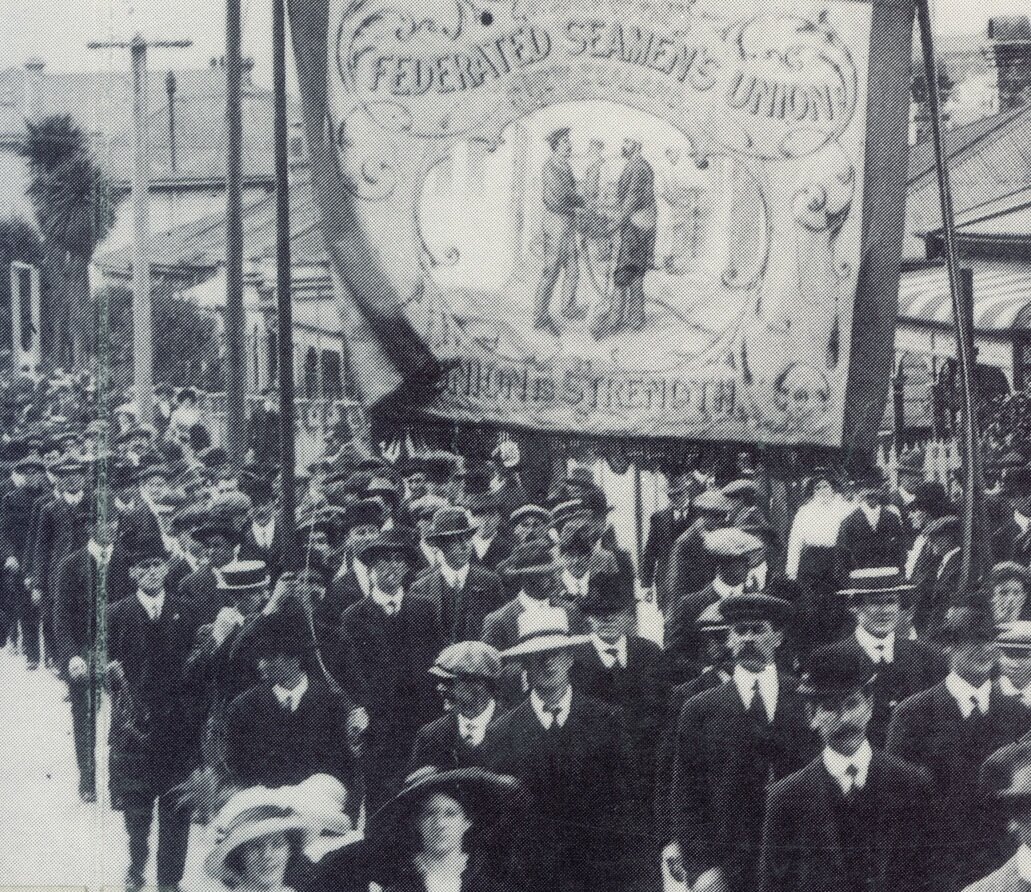
The Australian trade union movement today finds itself in a peculiar position. It remains, despite everything, the largest organised expression of the working class in this country. More than a million workers remain union members.
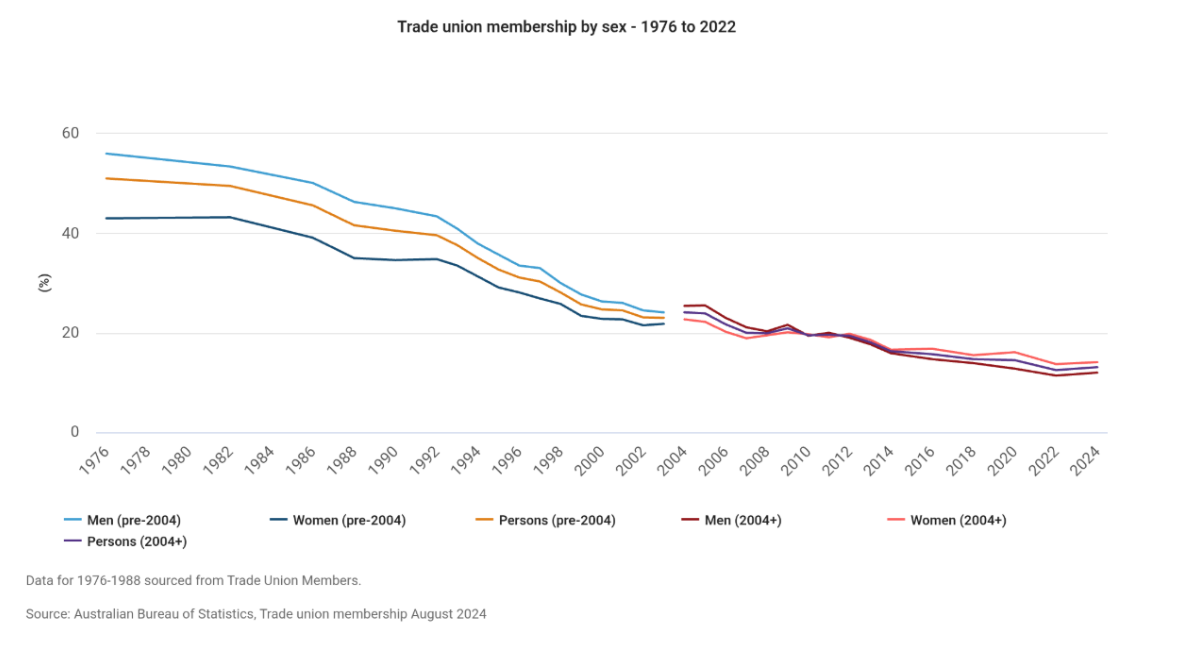
Every major industry still possesses some degree of union organisation, but at the same time, union density sits at only 12.5 percent of the workforce, which is a staggering collapse from the post-war period when more than half of Australian workers were card carrying members.
Today, the unions possess buildings, offices, paid officials, halls, social media departments and legal teams, yet they are woefully moribund, exercising less influence over working-class life than at any point in recent decades. The shell of what the unions used to be remains, but so much of that firebrand militancy and life force has drained away. But perhaps things are taking a turn again.
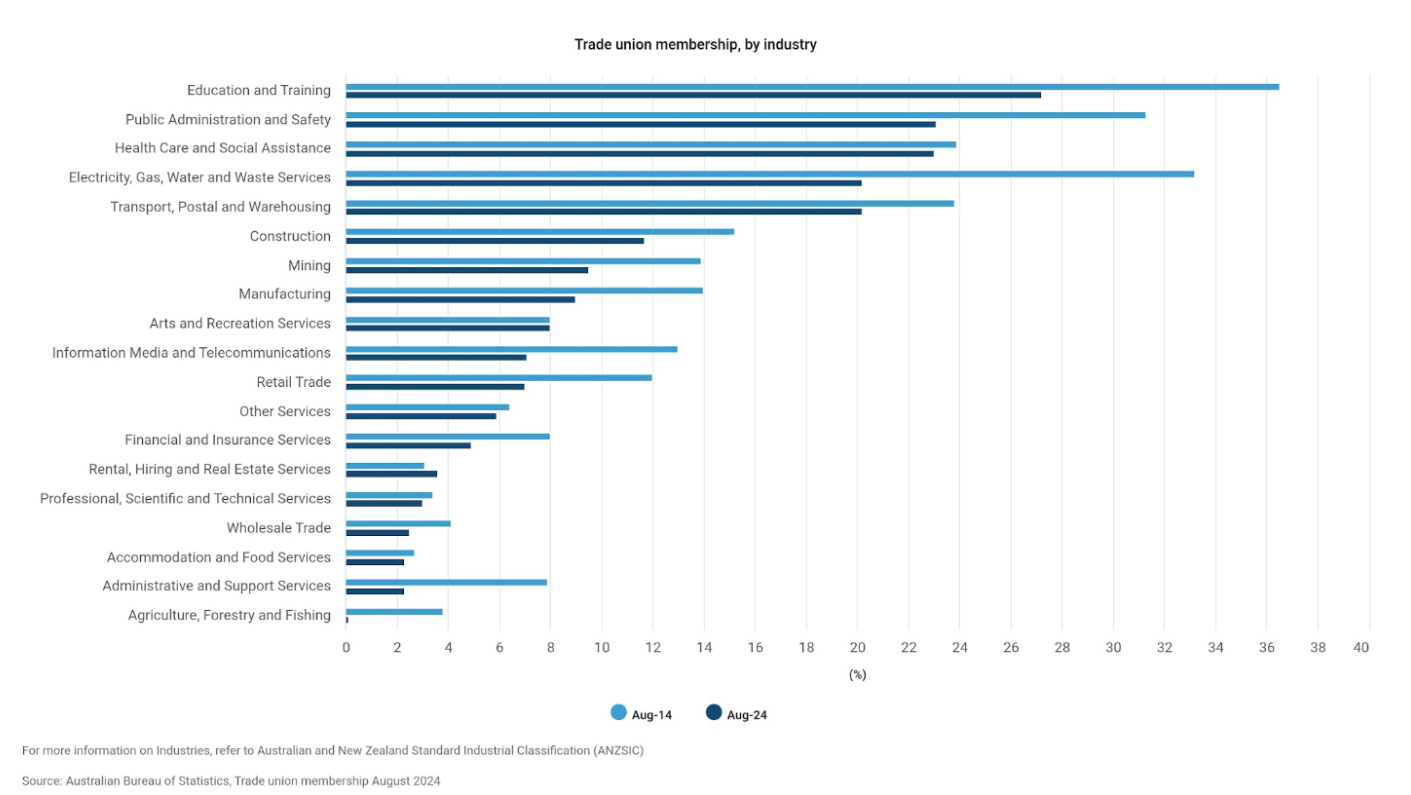
The contradictions of capitalism continue to illuminate themselves. Industrial action is finally on the rise again. After decades of stagnant wages, and the endless struggle against living in a world where everything seems to be impossible to afford, industrial disputes have begun to rise from the historic lows of the 2010s. While Australia has not experienced anything on the scale of strike waves witnessed across Europe and Britain, there has nevertheless been a noteworthy increase in industrial action across certain sectors.
In the education sector, the National Tertiary Education Union (NTEU), and the Australian Education Union (AEU), have both taken significant actions over the last several years. Most memorable was the AEU Victorian workers voting against an inadequate pay negotiation in 2026. Over thirty five thousand teachers walked off the job, for issues ranging from staffing and extreme workload burdens.
In healthcare, the Health Services Union (HSU), and the United Workers Union (UWU) has also made an emerging impact. Earlier this year, fifteen-thousand workers went on strike in Victoria over similar issues.
What is interesting is these struggles are developing within one of the most restrictive industrial relations systems in the advanced capitalist world. The ‘modern awards’ framework basically outlaws methods for solidarity action, strikes and sector wide industrial campaigns, reducing industrial action to tightly regulated enterprise bargaining disputes. In reality the law exists to manage class antagonisms in a manner acceptable to the capitalists.
The federal Labor government’s recent (2026) industrial relations reforms have introduced limited improvements in areas such as multi-employer bargaining and labour hire. However, most telling – they have left untouched the legislation that codified Australia’s anti-strike laws from the Keating and Howard periods.
The essential character of the industrial relations system remains unchanged: workers officially are ‘allowed’ to bargain, but only within narrow legal boundaries determined by the capitalist state.
The government’s ‘intervention’ into the Construction, Forestry, Maritime Employees Union (CFMEU) shows that even while organised labour has declined, militant, self-organised, anti-Labor and anti-bureaucracy sections of the union continue to be viewed as a threat.
Allegations of criminal corruption within parts of the leadership provided the justification for unprecedented federal intervention, with elected leadership removed and the union placed under government-appointed administration.
The allegations of corruption and criminal influence have been used by Labor as a means to implement its overarching ‘intervention’. Of course, the capitalist governments do not genuinely care about criminality within unions as they do using said allegations to crack down on genuine militancy and organised class-struggle. We must emphasise this. The extraordinary powers exercised by the state establishes a precedent for direct government intervention into trade unions, a precedent that should concern every organised worker, and especially communists.
The Australian trade union movement therefore exists in this current form. It is considerably weaker than at any point in much of the twentieth century, constrained by decades of legislative attacks and organisational decline. Yet the material conditions produced by Australian capitalism are once again pushing workers into class struggle. Whether these scattered disputes develop into a genuine revival of militant trade unionism will ultimately depend on the ability of workers themselves to rebuild democratic, class-conscious organisations capable of transforming fragmented and minor defensive struggles into a broader offensive against capitalism itself.
It is important to emphasise that the entire history of trade unionism in this country hasn’t always been characterised by reformism or parliamentarism, although these tendencies have played a major role. Rather, much of the history of unions has been a reflection of a contradiction between a militant rank-and-file base, and a class-collaborationist leadership.
To understand the current state of things, we need to understand our history. Namely, to distinguish between two related, but separate developments within the trade union movement in Australia. An emerging, and entrenching bureaucracy within the unions is not, in itself, the same phenomenon as the emergence of systemic class collaborationism.
Bureaucratisation is a tendency that has existed almost as long as permanent trade unions themselves. As workers organisations grow under capitalism, paid officials can form as a distinct social position from the rank and file.
Without robust accountability measures and a well organised internal democratic structure directly controlled by rank-and-fil membership – cliques develop and leadership is able to become increasingly insulated. Preservation of the leadership apparatus gradually becomes an end in itself.
Officials begin to prioritise maintaining their own positions, protecting their allies, and overseeing the organisation, rather than acting as direct delegates of workers they are tasked to represent.
This tendency has been a recurring aspect of trade union history for well over a century, if not lo9nger.
However, this bureaucracy alone does not automatically produce class collaborationism.
The transformation of union leaderships into institutions whose normal mode of operation is cooperation with capitalism and the bosses – rather than struggle against them – was largely a product of the post-war period. The reason for this distinction was because of how well capitalism in the post-war period was doing.
The economic boom, the expansion of the welfare state, institutionalised systems of collective bargaining, and the integration of union officials into state decision-making all materially altered the character of many trade union leaders.
Many union officials came to see their role not as organisers of class struggle, but as mediators between labour and capital.
Rather than mobilising workers to confront their bosses, they told them to manage disputes within limits acceptable to the bosses and the capitalist state.
The bureaucracy provided the organisational foundation for this qualitative shift, but it was the changing historical conditions of post-war capitalism that transformed much of that bureaucracy into an openly class-collaborationist layer.
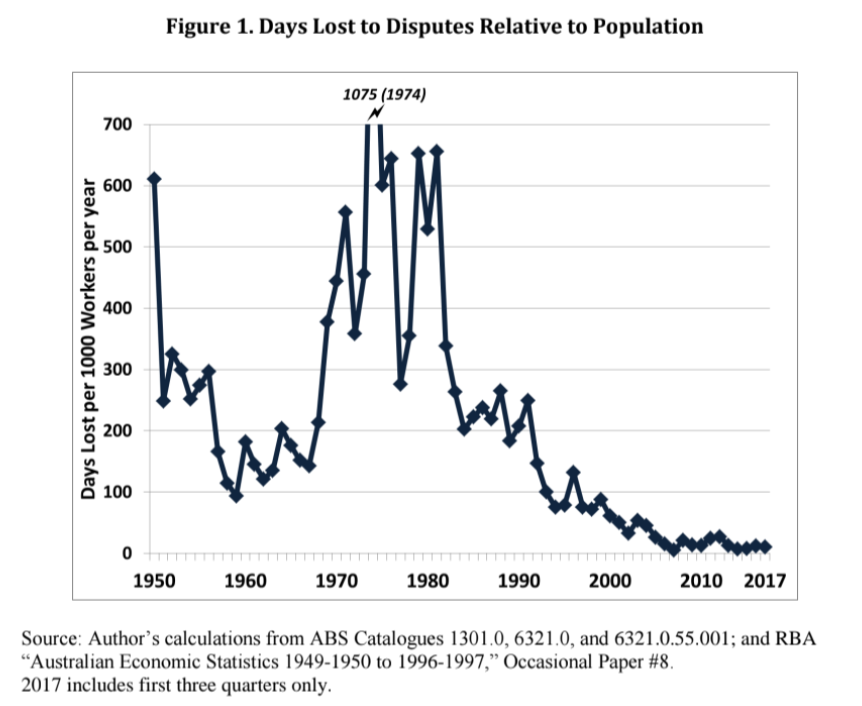
To understand how we arrived here we must begin with the post-war period.
Australian capitalism emerged from the Second World War in a position of relative strength. The Australian capitalist class found itself in a period of rapid growth of the productive forces, and a rapidly growing population. The economic situation was exceptionally ideal. Manufacturing expanded, infrastructure was developing more rapidly, and the Australian ruling class, very aware of the revolutionary upheavals that had shaken Europe and China, found it preferable to grant concessions rather than risk instability. Union membership was in the best shape it’d ever been. Throughout the 1950s and 1960s union density remained above fifty percent. In most industries, joining the union was not even a question. You joined because every worker around you was a member. Being in a union was a common sense notion for many workers and their families.
The concessions won during this period were not insignificant. Wages tracked fairly consistently with inflationary periods. Working conditions improved overall across different sectors. Public housing developments expanded in New South Wales, Victoria and South Australia.
Workers were securing concessions that previous generations, having suffered through imperialist wars and the Great Depression, could hardly conceive of. Importantly though, the capitalists could allow such concessions because of how well the economy was doing in this period. These gains also contained a contradiction. Unions grew stronger, but simultaneously a layer developed within them whose interests increasingly diverged from those of ordinary workers.
As unions accumulated assets, permanent offices, paid officials and institutional influence, a bureaucracy emerged that was in awe of the seemingly automatic growth of the capitalist system, and the resulting ability of the ruling class to grant concessions. Of course, this was not the result of bad individuals or moral failings. This was a social process, an example of a leadership choosing class collaborationism over class struggle. When union officials spend twenty years negotiating with bosses, attending industrial tribunals and meeting government ministers, they have come to see the world differently from the worker enduring the full force of brutal conditions, that is understaffing, wage theft or unsafe conditions on the factory floor. The bureaucracy became far removed from the workplace, increasingly insulated from rank-and-file pressures and finally integrated into the social and economic machinery of capitalist society itself.
This process was seen clearly during the Hawke-Keating period.
Before becoming Prime Minister, Hawke served as the president of the Council of Trade Unions (ACTU). Despite sitting in union council leadership during a period of general strike action against the Fraser attack on Medibank, Hawke would go on to perfectly encapsulate what class collaborationism does best. The pathway from the trade union bureaucracy into the Labor Party leadership was not left to chance. It was an expression of the deepened relationship between the two organisations’ bureaucratic layers.
The Accord signed between Labor and the ACTU in 1983 represented a key turning point for Australian unionism. Workers were told to moderate wage claims, and to curb industrial militancy. Class struggle was sold off for “national partnership”. The unions increasingly ceased acting as independent organs of working-class struggle and became junior partners in the management of Australian capitalism and its quelling of organised class struggle.
The consequences were tragic.
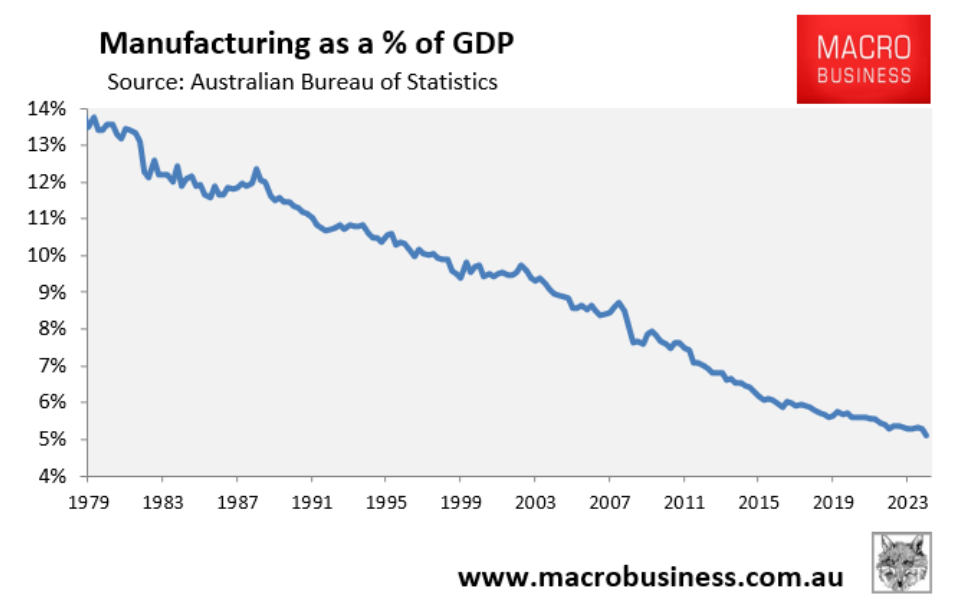
During the Accord years real wage growth slowed. Manufacturing jobs were systematically offshored and rapid deregulation and free market reforms accelerated. Financialisation expanded. Enterprise bargaining fragmented workers workplace by workplace, and collective bargaining was formally replaced with individual ‘bargaining’. Unsurprisingly, throughout much of this process the union leadership remained loyal to the Labor party and sold these attacks as necessary sacrifices in the ‘national interest’.
Importantly, we must understand the economic conditions that the Accord era was stepping out of, namely the Whitlam period of the nineteen-seventies. This was already a period where the post-war boom was seeing it’s decline.
Many of the reforms pursued by Whitlam, including the expansion of public services, investment in education and healthcare, and a broader role for the state in improving living standards, were not conceived of in a vacuum.
They reflected the assumptions of the post-war boom, a period in which sustained economic growth and rising productivity gave reformist governments far greater room to grant concessions to the working class while maintaining the overall stability of capitalism.
However, by the time Whitlam entered office in 1972, the material conditions that had made this model possible were rapidly fading.
The international recession of the early seventies, compounded by the oil crisis, marked the end of the post-war boom. As economic growth slowed, stagflation settled in, and unemployment rose – the capacity of capitalism to accommodate impactful concessions for the working class became more and more unfavourable.
It was these changing economic conditions that shaped the fate of the Whitlam government. Whitlam was attempting to implement a programme suited to an earlier period of capitalist expansion at precisely the moment capitalism had entered a period of stagflation and crisis.
The constitutional crisis of 1975 and Whitlam’s dismissal can only be understood through looking at the economic conditions that were pressuring the state into taking effective action to our manoeuvre Whitlams aspirations.
The era in which reforms could deliver meaningful concessions without challenging the profits of the capitalists was coming to an end.
By the time Hawke, and then Keating assumed office in 1983, this transformation was already well established. Unlike Whitlam, they did not inherit the final years of the post-war boom but governed after its collapse.
Consequently, Labor’s then reforms assumed a different character. Instead of attempting to expand the social safety net through growing public expenditure, the Hawke-Keating governments sought to restore the profitability and competitiveness of Australian capitalism.
The Accords, wage restraint, financial deregulation, tariff reductions, privatisation, and the restructuring of industry were all expressions of this period. Reformism had shifted from negotiating concessions for workers during a period of expansion to managing the working class on behalf of capitalism ina period of economic restructuring.
The union bureaucracy today remains bound to Labor by a thousand threads.
Most major unions remain formally affiliated to the Labor Party, pay formal affiliation fees, and send delegates to Labor party conferences. They also possess voting blocs within Labor’s internal political structure. This formalisation of the ties between union leadership and Labor party factionalism greases the wheels of the class collaborationist tendencies of both Labor and the union leadership.
Union officials consistently have moved into parliamentary careers. Labor MPs emerge from union offices. The careerist personnel move seamlessly between both organisations because they are, in many respects, part of the same apparatus.
This connection is not merely organisational. It is economical.
The Labor Party relies heavily upon trade union funding. Unions remain among Labor’s largest financial contributors. In return, the union bureaucracy gains access, influence and consultation. The result is a layer of officials whose political horizon rarely extends beyond electing another Labor government, regardless of whether that government is suppressing wages, carrying out privatisations or imposing anti-strike legislation.The absurdity of the situation becomes clear when we examine the legal framework governing unions today.
Australia possesses some of the most restrictive industrial laws in the advanced capitalist world. Workers can be fined for taking industrial action outside tightly prescribed bargaining periods, or approved days. Solidarity strikes remain heavily restricted. Secondary boycotts have been made effectively illegal. Union activity is buried beneath mountains of regulations, restrictive procedures and legal red tape.
Yet the union bureaucracy has largely adapted itself to these restrictions. Rather than mobilising workers to challenge anti-strike laws, they often act as their enforcers; furthermore, rather than encourage workers to push beyond legal limitations, they encourage workers to remain bound within them; tied by the ankle to the capitalist class that ensures union officials stay paid well.
These traitorous results have been catastrophic.
Union density stood above 50 percent throughout much of the post-war period. In 1992 it had fallen to approximately 40 percent. By the early 2000s it sat around 25 percent. Today it is roughly half that again. Among private sector workers the figure is even lower. Millions of workers have entered the labour market having never participated in a strike. Entire industries now exist where union organisation is weak, fragmented or entirely absent, particularly in precarious sectors.
This decline has inevitably shaped how young workers view unions.
For many young workers unions are neither hated nor loved. They are simply not even aware of them! A worker employed in hospitality, retail, logistics or the gig economy may spend years moving between insecure jobs without ever meeting a union delegate. The union exists, if it exists at all within the consciousness of young workers, as an email address, or a website, or maybe even a social media post. The lived experience of collective power has largely been forgotten, but this is slowly emerging once more.
Young workers face some of the worst conditions seen in generations. Housing costs have exploded to abhorrent levels. Secure employment has become increasingly difficult, if not impossible, to obtain. Student debt follows many into young adulthood, and real wages have stagnated.
The ‘promise’ that each generation would enjoy a better life than the previous one has completely collapsed before our eyes. Consequently, while many young workers remain disconnected from the traditional organisations of the working class, they are increasingly becoming aware of, and hostile towards capitalism itself. They are searching for answers. They are searching for methods and expressions of class struggle. They are searching for, and forming new, organisations capable of fighting. This is beginning to find expression inside the labour movement.
Organisations such as Unionists for Palestine and Trade Unionists for All represent an important development. While new, they obviously remain still quite limited in capability but they are emerging and growth is continuous, currently. Nevertheless, their new emergence reveals that a layer of younger militant workers are beginning to push against the narrow economism and conservatism of the official union leadership.
These activists and organisers instinctively recognise that workers cannot separate workplace struggles from broader political questions. The worker facing longer hours today may also oppose genocide tomorrow. The teacher fighting understaffing may also oppose racism, oppose sexism, and transphobia. The nurse fighting stagnant wages may also oppose war etc.
At the same time, as communists, it is important that we understand and avoid two errors.
The first is the tendency to fetishise trade unions.
Trade unions are not revolutionary by nature. Their form and historical function is an expression of organised class struggle and to defend workers against the attacks of the bosses.
The bureaucracy remains capable of restraining struggles and diverting them back into safe channels (for capitalism). To imagine that unions alone will somehow deliver socialist revolution is to misunderstand their historical role.
The second error is increasingly common amongst sections of the activist left.
Seeing bureaucratic officials and a certain conservatism within the unions, a layer of activist organisers in the climate or pro-Palestine movements have so far not made systematic attempts to connect these struggles to the struggles of the wider working class. But for these movements to succeed, they must bring in the largest possible organised layers of workers and youth. The unions are a key part of this.
The organised working class remains the only social force capable of fundamentally transforming society. The anger expressed through climate protests, anti-imperialist demonstrations and anti-genocide campaigns has the potential to find a broader connection with the organised rank-and-file of the working class. Equally, union struggles must break out of narrow workplace concerns and connect themselves to bigger political questions.
By bringing together workplace struggles and wider political struggles, a genuine mass movement could emerge that would pose a significant threat to the ruling class.
The coming years are increasingly unlikely to resemble the relative stability of the near past. The world is entering an epoch of war, economic crisis, political instability and sharpening class antagonisms. Capitalism is facing a downward spiral as a result of its own contradictions. Australia cannot escape this. Living standards continue to decline. Housing remains unaffordable. Public services are being eroded. Class anger is accumulating beneath the surface.
The union bureaucracy cannot solve these problems because it is tied by a thousand threads to the very system producing them. Labor cannot solve these problems because it remains a party for Australian capitalism.
What is required to solve the problems facing the working class is the conscious intervention of revolutionary communists.
Our task is therefore clear. We must build the revolutionary party. We must educate every cadre in the methods of Marxism. We must patiently explain, organise and prepare.
For decades the Australian labour movement has appeared dormant. The reformists have mistaken dormancy for death. They are not the same thing. Beneath the bureaucratic crust, beneath the declining membership figures, and the conservatism of the officials, the same social force remains that built every union, won every reform and carried out every strike in Australian history.
The working class is still here, and it will enter the stage of history once again.
When it does, and the crisis of capitalism guarantees that it will, we revolutionary communists must be ready, not simply to participate in events – but to lead them!
References
https://communist.red/the-australian-general-strike-of-1917-part-two/
https://www.parliament.nsw.gov.au/about/Pages/1939-to-1965-War-and-Post-War.aspx
https://www.macrobusiness.com.au/2025/05/how-australia-killed-its-manufacturing-industry/
https://marxist.com/britain-councils-of-action-for-working-class.htm
https://marxist.com/communists-trade-unions-and-the-anglo-russian-committee.htm
https://www.labourhistory.org.au/hummer/vol-3-no-1/reds/