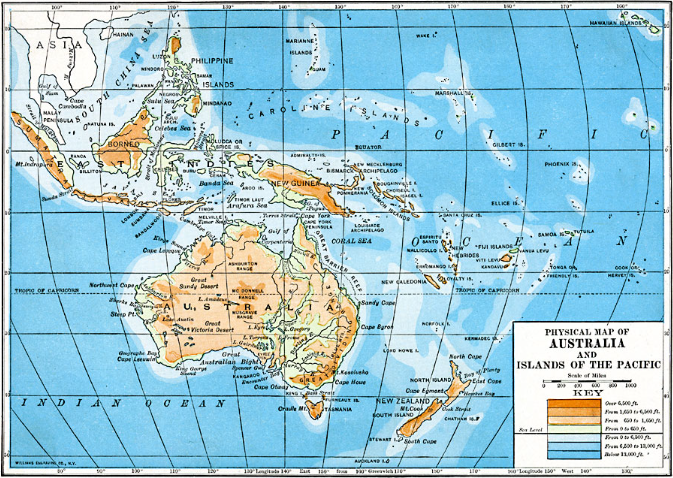
Established as a colonial outpost of British imperialism, Australian capitalism grew by extending its reach across the Pacific through financial domination and state coercion. Today it faces a world rocked by capitalism’s rotting system. With America’s relative decline and China’s power surging, the bosses are tightening their grip to protect their profits.
Their response is an increasingly desperate power grab. The same wealthy elite that throw their weight around the Pacific are tightening the screws on workers here in Australia. For Australian workers, the fight against imperialism starts with a fight against our own ruling class.
Colonisation and the Pacific frontier
Founded on genocide and dispossession, the emerging capitalist class in Australia viewed the Pacific as its natural target of expansion. These ambitions were inseparable from British capital, which financed much of Australia’s early expansion across the Pacific.
By the 1880s Australian agricultural magnates controlled large plantations in Fiji and Samoa, built on brutal labour regimes. Shipping companies played a central role in the kidnapping of tens of thousands of Pacific Islanders for the northern sugar fields. Burns Philp, a major Australian shipping line and merchant, developed a commercial empire stretching from Papua to Micronesia, profiting from highly exploitative labour practices, including debt bondage and harsh discipline. The Colonial Sugar Refining Company transformed Fiji into a plantation colony using indentured Indian labour, generating decades of extraordinary profits.
By the early twentieth century mining syndicates were carving up the resources of New Guinea and Melanesia. Australian companies poured capital into the Lakekamu and Yodda goldfields, while Burns Philp and the Papuan Exploration Company seized concessions for gold, copper and timber. The model was set: Australian capital would carry out aggressive private exploitation with the backing of its imperial bosses.
Rivalries and the reshaping of the Pacific
The Pacific was violently reordered by the two world wars. Before 1914 Germany controlled New Guinea, the Bismarck Archipelago and the northern Solomons. Its defeat in the First World War transferred these territories to Australian and Japanese rule. By the 1930s Japan held a wide arc of islands from Micronesia to the northern coast of New Guinea. Defeat in the Second World War dislodged it. Finally, Britain’s retreat from Asia created a new order dominated by the US. A network of American bases and supply routes now spanned the region.
The post-war landscape provided the conditions for Australian capital to assert itself. With its formal alignment through the ANZUS alliance of 1951, the ruling class operated under US hegemony. This has defined Australian imperialism ever since. The Australian ruling class plays the role of regional bully with ambitions of control, but it can only do so because it depends on the military and financial power of the US.
Financial domination and dependency
Australian imperialism does not rely on a single tool of power. It has built a whole architecture of economic domination that binds the Pacific to the interests of Australian capitalists. At the centre of this structure stand the big four banks, which dominate financial systems in Fiji, Samoa, Tonga, Vanuatu, PNG and the Cook Islands. They dictate spending priorities that favour private profit while starving public services.
Banking is only one pillar. Mining capital forms the backbone of this structure. Newcrest’s Lihir gold mine in PNG, one of the largest gold operations on earth, generated more than $1 billion USD in earnings in 2022. The surrounding communities remain among the poorest in the region; only one in five has access to electricity. The stark contrast shows how wealth goes to big corporations, leaving poverty in its wake.
Australia’s superannuation funds, controlling nearly four trillion dollars of workers’ deferred wages, have become major investors in Pacific mining and infrastructure. They claim to manage workers’ retirement, but in practice they utilise these immense funds as capital, to accumulate profit through the intensified exploitation of Pacific labour and resources. The savings of Australian workers are weaponised to extract profits from the Pacific.
The same logic governs so-called ‘development assistance.’ Australian construction giants such as Downer, John Holland and Transfield routinely secure the largest aid-funded contracts. Roads and logistics hubs are built not to meet local needs, but to service mining and telecommunications operations, controlled by Australian firms. ‘Development assistance’ is just another handout to Australian corporations, and ensures their dominance within Pacific markets.
Telecommunications has been folded into this expanding order. Telstra’s acquisition of Digicel Pacific locked in control over regional mobile networks. Undersea cables such as the Coral Sea Cable physically bind the digital arteries of PNG and Solomon Islands to Australian corporate systems. In the twenty-first century, this is of similar importance to controlling the shipping routes.
Labour mobility schemes deepen the dependency further. Tens of thousands of Pacific Islanders work in agriculture, meat processing, tourism and care through the Pacific Australia Labour Mobility (PALM) program. As of 2025 more than thirty-one thousand workers were employed through PALM, consistently in conditions of extreme exploitation and low wages. This provides the bosses with a reliable source of cheap labour for sectors that are critical to Australian capital, since remittances form some of the largest income sources for Pacific states. In Tonga, remittances exceed forty per cent of GDP. The schemes tie Pacific economies to the export of labour power, while exposing workers to exploitation and hardship in Australia.
Taken together, these financial, industrial and labour mechanisms form a single structure of control. They allow Australian capital to dictate terms across the region and pave the way for the state to bully Pacific governments to ensure favourable conditions for capital accumulation.
Role of the Australian state
The Australian state exercises extensive coercive power across the region. The Regional Assistance Mission to Solomon Islands (RAMSI) was presented as a peacekeeping operation. In practice it represented a direct assertion of Australian authority. For more than a decade Australia controlled large sections of the public service, stabilising conditions for the rich to continue to profit.
Through the Enhanced Cooperation Program hundreds of Australian police operate inside PNG, shaping administration and policy. Similar deployments occur in Tonga, Vanuatu and Fiji. These bullying tactics are sold as help, but they function to prop up the ruling class in these countries, so that they can better serve the interests of Australia’s wealthy bosses.
State-backed funding rorts are playing a bigger role in satisfying corporate greed in the Pacific. Export Finance Australia and the Australian Infrastructure Financing Facility for the Pacific (AIFFP) issue concessional loans and guarantees that direct public money into private contracts linked to Australian commercial interests. Climate finance is being used in a similar way. New funding schemes package rising sea levels and extreme weather as opportunities for Australian firms. The Pacific Climate Infrastructure Financing Partnership channels public money into the pockets of the corporations. These capitalist tools trap Pacific nations into new long-term debt and secure huge profits for the bosses.
The offshore detention regime in Nauru and Manus Island reveals a deeper continuity in Australian imperialism: the long-standing use of Pacific territories as a buffer zone to enforce the racist policies of the capitalist class and protect the internal order of the Australian state. From the nineteenth century, the ruling class viewed the islands north of Australia as a defensive buffer; territories that could absorb unwanted people and help preserve the White Australia policy by keeping ‘undesirable’ migrants out.
In the modern era, PNG and Nauru were pressured into hosting prison camps operated by private contractors such as Transfield and Wilson Security, generating billions in guaranteed contracts. The scheme revealed a broader truth: the Australian state treats the Pacific as an extension of its own territory.
These moves do not show confidence; they show fear. The AUKUS pact marks a sharp escalation in this direction, diverting billions from health and education into the pockets of wealthy capitalists. The regional imperialist ambitions of the Australian capitalist class arise from their fears of economic downturn and social unrest at home, and their desperation to bulwark their near abroad against the growing imperialist tensions between the US and China in the wider Pacific.
Combined and uneven development
Pacific societies bear the deep scars of combined and uneven development created by imperialism. Trotsky explained that capitalist expansion, particularly in countries dominated by imperialism, does not produce uniform progress. It fuses advanced and backward elements into a single, deeply contradictory system. Development across the region reflects the distortions imposed by foreign capital, rather than an inherent backwardness of the Pacific islands.
PNG illustrates this with clarity. It is one of the most resource-rich countries on earth, with vast deposits of gold, copper, oil and gas. The PNG LNG project operated by ExxonMobil is one of the largest and most technologically advanced industrial developments in the southern hemisphere. Yet the majority of PNG’s population lacks reliable electricity and basic services. Around 40 per cent survive on less than US$2.15 a day.
The combination of high-tech extraction coexisting with grinding poverty produces enormous social tension. Conflict and political instability are direct expressions of the imperialist impositions on the country.
For the Australian ruling class this volatility is a source of anxiety. As the region destabilises, the capitalists move to shore up an order slipping from its control. The state has responded by doubling the infrastructure financing facility, flooding the region with officials, and tying itself ever closer to US imperialism through AUKUS.
However, the more the state intervenes, the more it collides with the explosive social conditions of the Pacific. These interventions do not resolve the contradictions; they reproduce and deepen them.
Rising struggles across the region
The role of imperialism in the region has led to an escalation of the struggle for national liberation, as well as the class struggle. Bougainville’s conflict from 1988 to 1998 was sparked by the imperialists’ extractive policies at Rio Tinto’s copper mine, exposing the brutality of foreign mining capital.
Solomon Islands saw major unrest in 2021 and 2024, driven by youth unemployment, corruption and decades of resource extraction that enriched foreign firms while impoverishing communities. Papua New Guinea experienced a significant uprising in January 2024 centred on public sector pay and the rising cost of living. Strikes at Porgera, Lihir and Ok Tedi point to growing discontent among a wide layer of society. The ongoing conflict in West Papua continues despite heavy repression, demonstrating the persistent tensions that have been inflamed by imperialism in the region.
These movements are uneven and often fragmented. Their leaderships are not yet able to offer a definitive solution to the problems people face. But they reveal that the masses of the Pacific are no longer willing to accept the social order imposed upon them, and to this extent a growing layer will reach anti-imperialist conclusions.
Lenin insisted that in nations oppressed by imperialism the local ruling class is incapable of fulfilling their democratic tasks. Their wealth depends on foreign capital and they fear the mobilisation of the masses more than they fear foreign domination. National independence, land reform and genuine freedom cannot be achieved by elites tied to imperialist finance. The struggle for these basic tasks immediately collides with the interests of foreign investors.
Across the region, therefore, Pacific leaders consistently show themselves incapable of breaking with imperialism. Their class position ties them to foreign capital, and their political survival depends on reproducing the very structures of dependency that hold back the development of their societies.
In the Pacific this is not abstract theory. It is the living content of permanent revolution. The democratic and socialist tasks fuse into a single process that only the working class, allied with the poor and exploited masses can complete.
United class struggle
Imperialist expansion sharpens class conflict within the oppressor nation itself, because the struggle for resources and dominance forces the ruling class to intensify exploitation at home. In Australia, this is reflected in the use of anti-strike legislation to keep export terminals running for the mining giants, and in the diversion of hundreds of billions into AUKUS while workers face declining wages and attacks on living conditions. The same ruling class that enforces order overseas imposes austerity and militarised policing at home.
Opposition to Australian imperialism is therefore not a question of charity toward the peoples of the Pacific. It flows from the class interests of Australian workers themselves. As Lenin argued against tsarism’s colonial wars, workers in an oppressor nation can play a revolutionary role only by rejecting their own ruling class and their oppression. Every blow that weakens the machinery of Australian imperialism strengthens the struggles of Pacific workers and peasants.
Concrete avenues already exist. Dockworkers can halt the movement of military equipment. Transport workers can impede deployments. Unions can expose the role of mining firms and contractors in Pacific exploitation. The struggle against imperialism abroad and the fight against austerity and repression at home are one and the same.
Workers’ fight for a free Pacific
The peoples of the Pacific do not face a choice between which imperialist power will oppress them, since this is no choice at all. The only choice is between continued dependency and a decisive break with the capitalist system. Lenin wrote that imperialism is the eve of the socialist revolution of the proletariat. A regional order based on democratic planning and workers’ control of resources is the only framework capable of resolving the outstanding historical tasks confronting the Pacific. A Socialist Federation of the Pacific, as part of a World Socialist Federation, would free the region from competing imperialist pressures, end the cycle of dependency and allow for rational development according to human need.
This requires the independent political organisation of the working class in Australia and across the Pacific. The task before revolutionaries is to construct precisely that leadership: a party capable of linking the struggles against imperialism in the islands with the fight of Australian workers against their own ruling class. Only through such a movement can the region be transformed from a battleground of imperialist powers into a region united through workers’ solidarity and collective control of its vast resources.