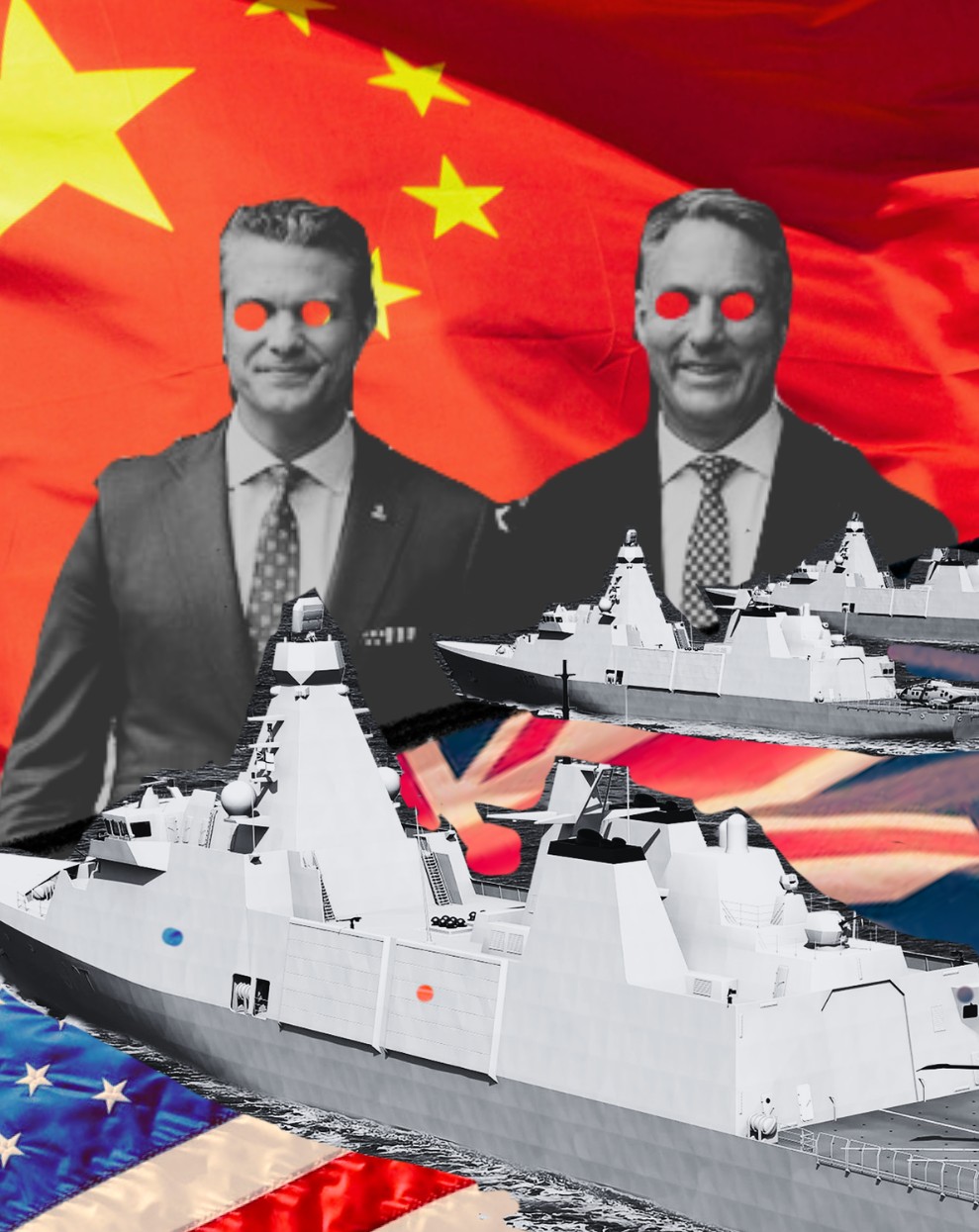
How much would be a ‘reasonable’ amount of money for a government to spend on three navy warships? A couple of billion, maybe more? 27 billion dollars is the figure cited in the recent Labor party budget.
This sort of money could feasibly build anywhere from 50,000 to 100,000 permanent homes – which would almost completely house the entire Australian homeless population. Something that would greatly alleviate the severity of the housing crisis.
It could be put towards building over a dozen brand new, modern hospitals on the level of Bankstown’s hospital project.
It could be put into the public school budget, for the educational development of Australia’s children for decades.
It could be put towards significantly building and upgrading Australia’s crumbling rail infrastructure, bringing us closer to something similar to a high-speed rail system – at least between Adelaide, Melbourne, Canberra, Sydney and Brisbane.
Any of these options, that would go towards the real benefit of Aussie workers and their families – for the price of three – count them! – three whole warships!
But this is where the priority of Australia’s capitalist parties sits. Albo and the rest of the ALP would rather spend money on warmongering with the United States and Britain, against China.
But with this arms race policy of AUKUS, it does not end with a measly three warships. The Department of Defence has published its projected budget on military expenditure.
Currently, the capitalists’ government estimates it will spend 81 billion by 2030, and an insane $887 billion by 2036! All for “delivering an accelerated capability for the integrated, focussed force – to increase the ADF’s self-reliance and contribute to regional deterrence” (our emphasis).
Cutting through the bourgeois corpo-speak, what they mean by “regional deterrence” is nothing less than imperialist militarisation in the face of the current global inter-imperialist tensions.
Take it from the horses mouth:
“[Australia’s]… national defence strategy 2026 affirms that Australia faces its most complex and threatening strategic circumstances since the end of World War Two,”
Defence Minister Richard Marles said at the press club in Canberra.
“International norms that once constrained the use of force and military coercion continue to erode. More countries are engaged in conflict today than at any time since the end of World War Two, and this is occurring across every region of the world.”
These aren’t the words of a Marxist, and yet the message is clear. Australia is not immune from the arms race and endless bloody conflicts smacking the entire surface of the globe.
The Labor party’s budget announcement emphasised a focus on “securing Australia’s fuel supply and strengthening strategic reserves“. The recent escalation in the Red Sea and the Saudi pipeline plan blown to smithereens has already thrown a Houthi rebel’s spanner into the mix, if at least only temporarily.
But this is not a case of the leadership of Labor choosing the more evil of two options. It would likely be this way if any of the capitalist parties were in the seat. It isn’t that it is more preferable to invest in war than it is social welfare – it is that capitalism demands it. Lenin stressed that imperialist conflicts are the consequential end state of capitalist competition.
Australia is economically and politically bound up in an imperialist contradiction between the United States and China. China remains Australia’s largest expert market, but Australia is also politically bound to American imperialism, and has been so for decades. Australian politics has played a balancing act and is still trying desperately to not fall on either side, but this current crisis of capitalism is shaving slivers off of this balancing beam. Australian governments for decades have tried to maintain lucrative economic relations with Beijing while remaining traditionally entrenched in its imperialist alliance with Washington. That contradiction is worsening, and its quality may soon change, because it is rapidly getting harder to manage for the capitalist parties.
Neither Albo, Taylor, Hanson or Waters will be able to reinforce this precarious beam, despite all of their promises. So long as Australia remains in the hands of the capitalist class, its political leadership will lead us all off the edge, jumping feet first into the abyss.
Capitalist parties do not serve the interests of the working class and the masses. They all must serve and organise Australian society around capitalist accumulation and the defence of that accumulation. Taxing the big capitalists a bit more is a reactive half-measure to a systemic problem. We must expunge the rot at its core – the mode of production that allows Gina Rinehart and her ilk to bleed us workers dry.
We need to transcend this system built around global financial and military competition so that Australians can finally organise their lives truly peacefully and free.