
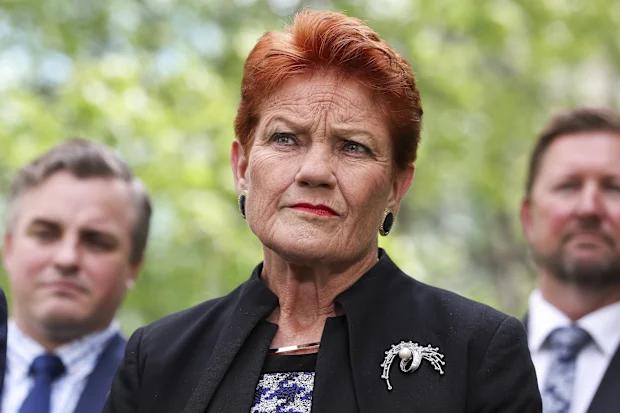
The Australian political scene has been subject to a shake-up never seen before. The once steady Labor-Coalition duopoly has become massively discredited in the eyes of the working masses. Labor has failed to improve the lives of workers at home and has backed the Israeli state while it carries out its genocide on Gaza and atrocities in the West-Bank, while the leadership of the Liberal-National coalition have floundered about. Consequently, One Nation has seen a serious bump in the polls, primarily due to its anti-establishment veil.
A very similar process of right-wing populists dominating the political sphere has taken place in most parts of the developed world and, having seen the impact of Trumpism and similar phenomena, Australian voters will likely be more cautious of these ‘underdogs’. This, combined with the subjective factor of the One Nation leadership being less successful in playing to their strengths than their overseas counterparts, has meant their stance in the polls is a less certain indicator of what is to come.
The future of Australian politics is yet to become obvious and depends on many factors, but what is clear is that this is an unprecedented situation that communists must be able to explain. This tectonic shift, accelerated in the fallout of the Bondi massacre, is a less than simple phenomenon to understand, and has been misinterpreted by both the left and the right. Here we will set the record straight.
Shaky ground
At root, the shifts taking place in the political and social plane are a reflection of Australia’s economic stability being swept from under its feet. Australia, once a bastion of stability, both politically and economically, on the domestic and international field, has struggled to recover from the global economic crisis triggered by the Covid-19 pandemic.
This has been a dramatic change from Australia’s relative economic success in the past. The combination of a reliable commodity export foundation with steady demand for raw materials from across the world, and a strong service-based domestic economy, had allowed the country to weather almost every major crisis in recent decades without entering recession.
Holding the OECD record for the longest uninterrupted growth without entering recession, it’s no wonder Australia has garnered the nickname: ‘The Lucky Country’. Since the last recession of the early 90s, Australia’s relatively high living standards were stunted by the global crisis caused by the Covid-19 pandemic. The ensuing recession felt in all parts of the world had a profoundly negative impact on these metrics. Australia’s recovery from the recession, relative to the rest of the world, leaves much to be desired, particularly with inflation and housing prices rising far faster than wage growth. A Lowy institute poll shows the average Australian is more pessimistic about the economy than at any time in the past 20 years – understandably so!
Access to vast amounts of valuable raw materials, most notably iron, coal, gold, oil, and other rare metals, alongside a strong education, technology and finance sector, has made Australia one of the wealthiest countries in the world, sitting at 3rd for median wealth behind only Luxembourg and Belgium.
But this apparent ‘success’ is certainly not felt by the vast majority. In 2021, Australia had the 8th highest cost of living in the world according to the World Bank. This was before much of the worst of the economic impact of the Covid-19 pandemic. Workers are committing more time in their workplaces than ever, wrapped up with the ‘productivity crisis’, it is no wonder that those on the ground day in and day out are growing contemptuous of the political establishment.
With the housing crisis serving as a flashpoint of debate, all parliamentary parties have failed to deliver a clear analysis of why we are in this situation. Naturally, when explaining capitalist economics, these parties must wrap up their arguments with mysticism and distortions, because an actual explanation serves to oppose the interests of the system as a whole.
The duopoly have never been interested in outright opposing anti-immigrant rhetoric and combatting racism, rather, even supposedly ‘left-wing’ parties have fed into the toxic culture war. One Nation has been able to exploit and worsen this sentiment in their own interest, but both Labor and the Coalition are also responsible for promoting racist ideas in mainstream politics for decades.
More recently, the developments of the US-Israeli war on Iran and the closure of the Strait of Hormuz have further exposed the traditional parties, with the eagerness of the establishment in backing the imperialist aggression resulting in economic turmoil and a further deterioration of trust from the masses. As fuel shortages ravage the world, leaders have scrambled to secure supplies and shield their domestic economy.
Pauline Hanson has publicly praised Donald Trump’s intervention in Iran, while criticising the response of the Labor government, who have also supported the war, both in words and in deeds. As contradictory as that may seem, this has not negatively affected One Nation’s stance in the polls. This is a testament to the fact that the party’s success doesn’t come from appearing to have a solution for the problems facing the masses, but merely from its opposition to the actions of those in power.
The immense shock felt by the workers and youth is leading to an uncertainty and political polarisation like never before. The Labor-Coalition duopoly has proven to be out of touch and short-sighted, causing massive shifts, both to the left, as well as to the populist underdog co-opting a chunk of this anger and pulling it to the right. For One Nation, holding onto this layer will prove difficult when they are expected to implement their program, as their policies rely almost solely on anti-immigration and protectionist sentiment, which can only lead to more instability and disappointment.
Political vacuums
A key factor in One Nation’s success is that a large portion of traditional conservative voters have jumped ship to the only party on the right seeming to have their act together. The unprecedented crisis in the Liberal leadership and the no less disappointing ‘counterweight’ of the Nationals has opened up a slot that One Nation has stepped up to fill. The Coalition’s ‘on again, off again’ relationship has certainly done them no favours in the face of general dissatisfaction with Labor.
One Nation has an interest in remaining independent, as their relative strength is derived from being singled out by the establishment. The hot breath on the neck of the duopoly and the establishment’s resulting opposition to One Nation is reciprocally contributing to their rising support. This almost decisively rules out their joining the Coalition, though this will become clearer the closer we are to the next federal election. Assuming they retain their current base of support, they will certainly remain independent.
Given the increasing uncertainty and alienation felt by regular Australian workers, it’s no wonder a party leaning heavily into nationalism and ‘shared identity’ is able to have such an echo. In the absence of a mass, genuine left-wing force capable of making the case against racism and exposing the vile rhetoric of reactionaries like Hanson, this will continue to be the case. What is needed is a program of independent working class unity.

Yet there is also a vacuum present on the left, both the revolutionary and the reformist. No lack of appetite is present in Australian society for a genuinely left-wing movement or party, as demonstrated by mass youth opposition to Israel, so it leaves one scratching their head why no Mamdani- or Polanski-type has stepped up with bold revolutionary-sounding rhetoric. Labor certainly burnt their fingers with the Gough Whitlam affair and have developed an internal bureaucracy that will likely never allow a left figure like that to return to the top.
No less inept in the realm of a genuine opposition to One Nation are the Greens, with constant denunciation instead of a correct analysis. Most of their leaders’ arguments boil down to a stinking pessimism, that workers are becoming more racist and stupid, that One Nation poses a threat to our ‘democracy’, and that capitalism is the only possible framework for a better future. If they dared to step left of their established bounds and put on a radical face, they would doubtless see a bump in polls, but for now this does not seem to be on the horizon.
Needless to say, One Nation’s anti-establishment appearance is a thin veil, as Pauline Hanson’s very public friendship and backing by billionaire Gina Reinhart clearly demonstrates. Their general ideology as populists is little more than abstract nationalism, with a resulting anti-immigration and protectionist economic policy, combined with poisonous racism and bigotry. This is not much that hasn’t already been observed in a chunk of the developed world.
The uniqueness of the party lies in Hanson as an individual; she’s not a new insurgent figure like Trump was, as she’s been floating around for decades, and the pre-existing party nucleus is a heavy factor in why they’re rising to fill the vacuum on the right. Hanson, however, has long been dogmatically committed to her toxic ideas, and likely won’t be as flexible on policy ideas as her overseas populist counterparts.
Whereas Trump will cook up policies in the heat of the moment to suit his interests, Hanson will prove more stubborn, and genuinely wants to carry through the outlandish racist policies which would only serve to tank the Australian export-driven economy.
Revolutionary Alternative
The main lesson to be drawn from the rise of One Nation is that there is widespread and legitimate anger at the political establishment that is desperate to find an expression. Given the vacuum on the left, this anger is finding a distorted expression in One Nation. But Hanson offers no alternative to the rotten establishment and the crippled capitalist system.
No matter what party dominates parliament, the capitalist system they preside over will continue to spiral and prepare massive swings to the left, as the right-wing populist parties discredit themselves internationally.
The task of communists is to make clear that the epoch of meaningful economic bounce backs is quite behind us, which means the contradictions accumulating within society, both domestically and internationally, can only find themselves resolved through the conquest of political and economic power by the working class itself.
Mass upheavals are upon the horizon, and each capitalist party will only serve to disappoint the working class and prove their inability to steer the ship back on course. But these upheavals alone will not end the capitalist system, for that, a revolutionary party must be prepared in advance, to transmit the historic lessons of the labour movement to the masses and explain the need for the seizure of power over their own lives.