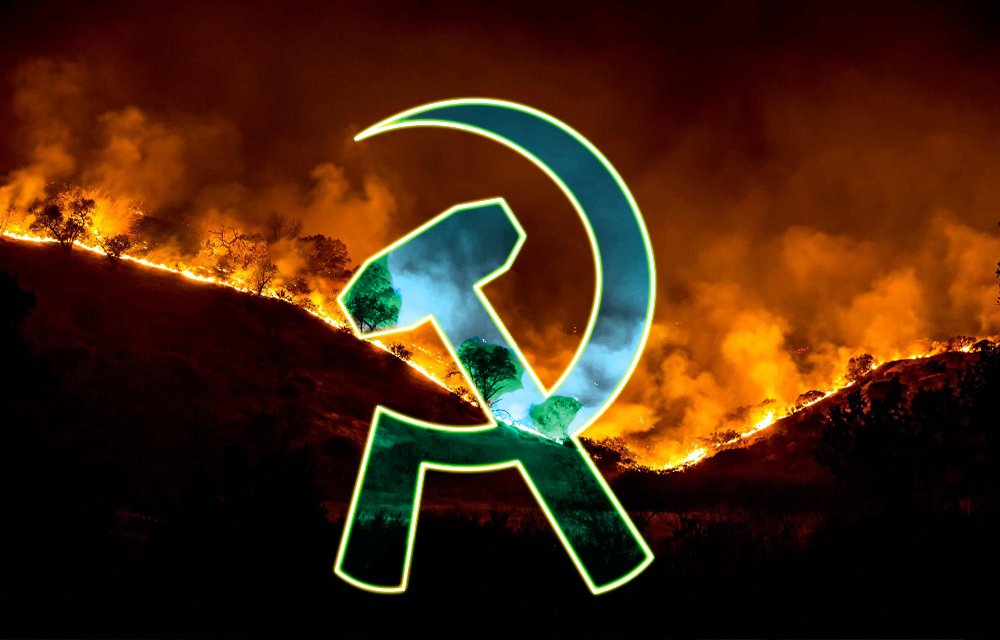
The climate crisis poses a catastrophic threat to the future of life on Earth. The capitalist classes of the world have beyond proven themself incapable of tackling this problem.
Alongside deepening economic crises, imperialist wars and political instability, millions are directly facing the devastating impacts of climate change, particularly those of the former colonial world. Exponentially worsening conditions of the environment as a result of the endless pursuit of profits are leading to a mass questioning of the very fabric of society, some arriving at revolutionary conclusions.
The workers of Australia – and the whole world – are looking to our so-called leaders, demanding answers and immediate action. Tearing down the barriers standing between humanity and the solutions to the crisis is more imperative and time sensitive than ever. Those barriers are private ownership of the means of production and the nation state. It is the task of the workers of the world to unite in struggle and break away from the capitalist system and its loyal defenders: the parliamentary establishment.
The Role of the State
The state only exists because of the deep rooted, unresolvable conflict between the ruling and oppressed classes: under capitalism, workers and capitalists. This divide isn’t precisely about personal wealth, but about your relationship to the means of production. If you don’t own means of production and must sell your labour power to survive, you are working class. Capitalists, on the other hand, own property and exploit the working class to grow their wealth. The state only arises as a result of class conflict. It is not a neutral body; under capitalism, it is the organised power of the capitalist class, built and wielded to protect their interests and their interests only.
Reformism, as an ideology, should not be confused with the fight for reforms. Revolutionaries and reformists alike fight for reforms that improve lives and raise political consciousness. What sets reformists apart is their belief that reforms to the capitalist state are sufficient to serve the working class. While they admit capitalism has its problems, they cling to the false hope that it can be fixed through regulation or electoral wins. In reality, this misleads workers into thinking change comes through voting, not struggle.
Parliamentary Illusions
Two party duopolies – in Australia the Labor-Liberal parties – are present in almost all bourgeois democracies. This is typically the preferred system for the capitalist class, as it concentrates their power amongst a small clique of politicians, whilst giving voters the illusion of democratic choice. Even with preferential voting, voters often choose between the “lesser evil” to avoid splitting the vote. Minor parties like The Greens, The Nationals, and One Nation still rely on alliances with major parties to have influence. Yet, the 2025 federal election saw historically low first-preference votes for both major parties, showing growing public disillusionment with the system.
The anger of the masses towards the failings of the Labor-Liberal duopoly is particularly evident on the
question of the climate crisis. Labour and the Coalition recently voted against a bill that would create a federal ‘climate duty of care’. It would have required the government to consider young people’s health and wellbeing when making climate related decisions. This is a clear message that the future of the planet matters less than the interests of their corporate donors. To them and their conniving class, whatever stands in the way of profits must be swiped aside with little consideration.
The Greens propose progressive reforms: ‘fairly’ taxing billionaires and big corporations, rent caps, dental and mental health in Medicare, wiping HECS debt. These would certainly help workers in these times of uncertainty – but in a period of capitalist crisis, even small concessions are not sustainable. When the bosses demand greater and greater exploitation, there is simply no room to bargain over an ‘agreeable’ level. We argue workers shouldn’t settle for small fixes when we can demand real power: Not just taxing billionaires, but expropriating their assets for public use. Not just favouring the environment over profits, but eliminating the profit motive entirely. Not just reducing living costs, but removing the cost of living itself – life should only require contributing your fair share of labour. The primary issue with The Greens is their failure to address the ultimate root of the climate crisis and the absolute necessity of doing away with it: capitalism and the class divide. The only way out is through working class independence and internationalism, The Greens’ actions and words lack class content and have proven themselves insufficient for progressing society.
The cold hard truth derived from the Marxist method of analysis is: this reformism ultimately sows passivity within the working class; holding back its full potential, lulling it with empty promises.
The Climate Crisis: Expansion at All Costs
Faced with mountains of evidence revealing how dire the situation truly is, the environment minister, Murray Watt, has approved the extension of one of the world’s largest liquified natural gas projects, the North West Shelf, from 2030 to 2070, his first decision made after being appointed to the position. He said the decision followed “the consideration of rigorous scientific and other advice, including submissions from a wide cross-section of the community”. Gas is of course a non-renewable fossil fuel, one of the biggest direct contributors to the greenhouse gas emissions driving climate change. This being said, he was not required to consider the impact on the climate crisis. Absurdly, with the country being wracked by the horrors of a worsening environmental crisis, climate change is not grounds for the restriction of a development under Australia’s national environment law. Further, it will cause extensive damage to Murujuga rock art, the oldest art gallery in the world, with the oldest known depiction of a human face. As is to be expected from the capitalist state, zero consideration has been shown for First Nations people, who have occupied this land for at least 65,000 years. The art created by the First Nations people played an important role as a conduit for cultural expression, storytelling and transmission of knowledge across generations. The devastating effects of colonialism live on, and will continue to live on until capitalism is dismantled.
Fossil fuel corporations in Australia are the primary contributors to the climate crisis, raking in billions in profit off the backs of the working class, often paying little or no tax. The vast majority of materials extracted from Australian land is exported; 88% of black coal, 74% of natural gas and 96% of crude oil sucked out of natural reserves is exported, amounting to over two-thirds of the country’s total fossil fuel production. Further, nearly a fifth of Australia’s emissions now come from exporting non-renewables. Being non-renewable has enabled the capitalist cartels to seize access to reserves and establish a market monopoly, allowing supply and demand to be controlled entirely in their favour. This is the primary reason renewable energy isn’t being pursued in the face of the climate crisis.
Under capitalism, it is big business that decides what is produced and how it is produced. But this is not done according to any plan but their own. Instead, our economy is left to the so-called ‘invisible hand’ – that is, to the anarchy of the market. Corporations will cut corners and run through regulations wherever necessary in order to reduce costs, outcompete their rivals, capture new markets, and maximise their profits. This race to the bottom, however, is not simply the product of greedy individuals. It is the logical result of the economic laws of capitalism: a system based on private ownership and competition, which leads to the most ruthless individuals rising to the top.
Devastating outcomes
A recent report compiled on coral reef ecosystems shows the planet’s first catastrophic climate tipping point has been reached. Reefs are facing widespread, potentially irreversible die off as a result of rising ocean temperatures and acidity levels. Drawing from 160 scientists from 23 countries, the report warns these systems are already crippling, a shift expected once global heating surpasses 1.2°C above pre-industrial levels, a threshold we have now crossed. Above 80% of reefs in 80 countries have been hit by the current global bleaching event, pushing ecosystems into territory never seen before.
Reefs are imperative for coastal biodiversity, home to countless species forming a deeply interconnected web of life. Covering only 1 percent of the whole ocean floor, they support 25 percent of marine species. They also provide a natural barrier against coastal erosion. Healthy reefs can absorb up to 97 percent of wave energy, protecting seawalls, homes and roads from storm surges, flooding and high waves. Not only are they vital for coastal environments, they are a valuable source of income from tourism and fisheries. Capitalism has become so crisis-ridden that it is indirectly attacking its own interests.
South Australia’s coast is experiencing an algal bloom crisis. Algae is a natural part of most water ecosystems, but the Karenia species infesting the coastline is causing large mortality. 3 rather rare environmental events have led to this development: Murray River floodwaters in 2022-23 brought extra nutrients into the sea, a cold water upswelling in summer 2023-24 lifted nutrients to the surface, and a marine heatwave since September 2024 has lifted water temperatures 2.5°C warmer than average. When the algae decays, it consumes oxygen from the water, leading to oxygen levels sinking below what is necessary for many marine species survival.
Tuvalu, an island nation midway between Australia and Hawaii, has become the first ever to plan the migration of an entire population due to climate change. It is likely to become the first country made entirely uninhabitable, with scientists predicting by 2100, 95% of its land will be submerged at high tide. In response, Australia and Tuvalu signed a pact opening visa pathways for 280 citizens to be granted permanent residency. The ballot drew 5,157 applicants, roughly half of Tuvalu’s population. This should serve as a stark warning; climate change presents a tangible threat to humanity in the here and now.
No Faith in Capitalist Solutions
It should be clear that our trust as workers cannot be placed in our rulers and their corrupt organisations; only ourselves. The contradiction between the fragile limits of nature, and the anarchic need for capital to endlessly expand its pursuit of profit, can only be resolved in one of two ways; the revolutionary overthrow of capitalism and the establishment of socialism, or, extinction. No amount of tweaking, reforming, or regulation to the way capital functions can bring it into harmony with the needs of the planet.
Corporate monopolies have already built extensive planning mechanisms to escape the inherent anarchy of the market and maximise their profits, by creating predictable conditions, planning their supply chains and producing according to profitable demand. The question is not whether large scale central planning can work, the task is its transformation into democratic central planning, based solely on serving everyone’s needs, not the interests of big capital. The capabilities granted to us by modern science and technology already have the potential to provide us all with a comfortable life, free from the 5 day 40 hour work cycle, all while slashing industrial impacts to bring harmony between the economy and the environment. Abolition of the profit incentive means we can abolish socially unnecessary labour, meaning all labour could be focused purely on the fulfilment of human needs and goals: whether they be simply physiological, or to do with security, belonging, and creativity. The incentive for wasting unsold produce to artificially inflate the market will be absent.
Instead of the commanding heights of the economy belonging to unelected individuals, collective ownership will be established and the economy subordinated to the will of the workers through local elected workers councils. All officials will be elected and subject to the right to immediate recall, with the abolition of monetary privileges, reducing their wages to no higher than that of a skilled worker. This is the bridge from capitalism to socialism, the true manifestation of the will of the workers. Accountability and control is what is mainly needed for the proper function of the first phase of communist society. All workers are handed democratic control over their state, the workers’ state, and are free to have a meaningful say in their society and their working life for the first time.
On this basis, the centralisation and democratic control of all instruments of labour, of all accumulated technical and scientific expertise, of all means of monitoring and organising production could begin the dismantling of the inefficient and environmentally destructive infrastructure created by profit-chasing expansion. Production could be adapted so that efficient and sustainable practices can take place. Vibrant greenery can reclaim its rightful place on the Earth, and we could see humanity’s true reconnection with nature – on a basis that would allow both to thrive. Landback and the returning of custodianship to indigenous communities must take place along democratic lines and their mentorship for reforestation, soil regeneration and land management can only be achieved on the basis of a socialist revolution. Without class struggle, environmentalism is just gardening.