
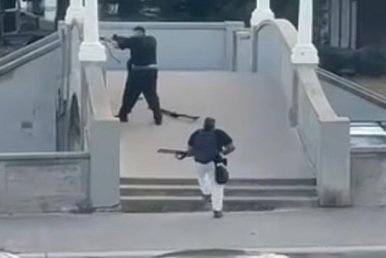
In December, two gunmen carried out the deadliest mass shooting Australia has seen in decades. This vile, antisemitic attack, inspired by Islamic State, took place during Hanukkah celebrations at Sydney’s Bondi Beach. In its aftermath, the Labor government initiated a brutal wave of repression, cynically using the attack to crack down on Australia’s pro-Palestine movement – the world’s largest outside the Middle East in terms of the number of major protests.
But this has not been the only fallout of the Bondi Beach attack. The government’s response has inadvertently led to an unprecedented crisis in the opposition Liberal/National Coalition – the traditional party of the Australian capitalist class – and the ensuing turmoil has sparked the seemingly meteoric rise of Pauline Hanson’s right-wing populist One Nation.
Barely ten months ago, Anthony Albanese’s Labor swept to power in a supposed ‘landslide’ victory that buoyed the optimism of the country’s exploiters and oppressors. At the time, we wrote that the apparent calm on the electoral front masked deeper contradictions that would sooner or later erupt in dramatic fashion.
Labor’s response to the Bondi Beach attack has now blown up in their face, and has revealed the fragility of the previously unshakable institutions of Australian bourgeois democracy, which until now had seemed to weather the crisis of world capitalism better than most.
Since Bondi, the naive optimism of the ruling class that accompanied Labor’s victory last year has been transformed into open anxiety, writ large on the pages of the capitalist press.
Labor’s provocations mask their weakness
The immense scale of Australia’s pro-Palestine movement since the beginning of Israel’s genocidal war on Gaza is a reflection of a vacuum in the class struggle. It is the other side of the coin of the apparent stability that Australian politics had seemed to enjoy compared to other countries. With bubbling class frustrations finding little expression in politics or the trade unions, angry workers and youth have consistently taken their anger to the streets in their tens of thousands, in solidarity with Palestine.
The undisguised class anger at the centre of these mobilisations, if given a more organised expression, has the potential to pose a tangible threat to the entire Australian establishment. Both the major parties have backed the genocide in Palestine whilst attacking workers and youth at home.
For this reason, the ruling class have long sought to disarm and demobilise the movement. Having failed to ameliorate the situation through symbolic concessions, such as recognising Palestine as a state, Labor was undoubtedly awaiting an excuse to exchange the carrot for the stick.
In this context, the government’s invitation of Israeli President Isaac Herzog to the Bondi Beach commemorations in February, can only be seen as a provocation. It was self-evident that the arrival of Herzog – who even the UN accuses of “inciting the commission of genocide” – would evoke a massive response. This is no doubt precisely what the government intended, in order to justify a crackdown.
While the Australian police are not known for their leniency at the best of times, the repression of the anti-Herzog protests marked a severe escalation.
The abundant footage on social media, filled with the terrified screams of the protestors, makes for difficult viewing. Police officers indiscriminately attacked peaceful protestors, including children and the elderly. Many were beaten, dragged by their hair, and kicked whilst on the ground, often by multiple officers simultaneously. 69-year-old Jann Alhafny, whose Palestinian husband was forced to flee his home during the Nakba, was hospitalised with four broken vertebrae.
Police officers also targeted Muslim protestors in the middle of evening prayer, as Abigail Boyd, a Green Party lawmaker who was herself beaten by the police, described:
“There was a group of people who were praying because it was evening prayer time. There was maybe 12 of them. They were praying peacefully and it was clear that the police were wanting to move them on in the middle of their prayer… They then went in and grabbed these people who were praying. You can’t get anything more peaceful than prayer. Picking them up and just throwing them on the ground again.”
These protestors made up the “angry and violent mob”, described by New South Wales police chief Mal Lanyon, against whom the vicious police thugs showed “remarkable restraint” and “did what they needed to do”.
The shameless hatred for the masses shown by Lanyon and all the officers involved in the attack on innocent protestors has been met with the disgust of workers and youth, both in Australia and internationally. Albanese did little less to disguise his contempt. He described the scenes of police violence as “devastating”… before throwing the blame on the anti-genocide demonstrators themselves, who he accused of “undermining” their own cause – a cause which he has made abundantly clear that he does not share.
The crackdown at the anti-Herzog protests was intended as a coup de main, to strike fear into the pro-Palestine movement and thereby end this nuisance for the ruling class once and for all. It would be a mistake, however, to view this as a show of strength on the part of the capitalist class.
In a country that has long prided itself on espousing democratic, peaceful values, brutal shock-and-awe tactics are a weapon of last resort. The ruling class has tried for years to shut down the pro-Palestine movement. The desperation of these attacks shows their true fear.
As subsequent demonstrations have shown, the escalation of repression has not stopped the movement. Instead, it has embarrassed Albanese and the Labor Party both at home and on the world stage.
Due to lack of any alternative, Labor has still just about managed to top the polls since the election, but its grip is weakening and its support has been steadily in decline for almost a year now.
Albanese’s response to the Bondi attack was meant to turn this around, and reinforce Labor’s position. In reality, far from strengthening Labor, Albanese has deepened its anxieties by further discrediting the party. Yet the crisis of the establishment catalysed by the Bondi attack is not limited to Labor.
Coalition in crisis
The Combatting Antisemitism, Hate and Extremism Bill 2026 was presented as Labor’s assurance that they were taking hate crime seriously in the wake of the Bondi Beach attack. In reality, it is not hard to foresee that the expansion of police powers and the new, vague definition of hate crime are yet another potential weapon against the pro-Palestine movement.
What the capitalist class likely did not foresee, however, was that the bill would precipitate the latest in a string of recent crises in the Liberal/National Coalition – the hallowed union of the parties of Australia’s urban and rural bourgeoisie that has existed in some form for over 100 years.
The Nationals’ concerns over ‘restrictions on free speech’ in the hate speech bill led them to abandon their positions as shadow ministers and temporarily dissolve the Coalition. After almost 40 years of Coalition politicians amicably collaborating without any splits, this is the second time the Coalition has been temporarily dissolved in less than 12 months.
While every acrimonious dispute within the Coalition has so far been ‘resolved’, this is little more than papering over the cracks. What we are seeing is the protracted, terminal decline of the most powerful capitalist party in Australian history.
The fate of the Coalition hangs in the balance now more than ever. The recent dispute over ‘free speech’ is nothing but a mirage. There are good reasons for the Nationals to want a more permanent split, or at least to radically alter their position as the junior partner in this increasingly unhappy marriage.
The number of metropolitan seats held by Coalition MPs is at a record low compared to the number of provincial/rural seats they hold. It remains to be seen whether the Nationals – the “rural conscience of the Coalition” – think they could be more successful on their home turf by cutting themselves free from the moribund inner-city elites at the top of the Liberal Party.
Even the recent ousting of Sussan Ley as Liberal Party and Coalition leader – who retired from politics with an impressive minus 40 percent approval rating – has done little to assuage concerns about the viability of the Coalition.
Her replacement, Angus Taylor, is variously described by mouthpiece of Australian capitalism the Financial Review as: “underwhelming”, “hopeless at politics”, “irrelevant” and “struggling to say things clearly”. In the words of Taylor’s Liberal Party colleague, former prime minister Malcolm Turnbull: “what a lot of people say about Angus Taylor is he is the best-qualified idiot they’ve ever met”.
The capitalist class can no longer rely on the Coalition to function – let alone govern! – and are freely admitting this in article after article. The fallout of the Bondi Beach attack has been catastrophic for the Coalition, as the parties’ incompetence and incessant infighting have once again been put front and centre.
This has happened precisely at a time when the ruling class needs a reliable opposition to soak up the growing resentment against Labor. Instead, that resentment has gone elsewhere over the last few months, and Australia’s previously unshakable two-party system is now endangered by what in the past would have seemed an impossible threat.
Hanson’s rise
Millionaire perennial politician and former fish-and-chip shop magnate Pauline Hanson is in many ways an unlikely insurgent figure. She is a seasoned veteran of the fringes of politics, with an extensive 30-year political career littered with innumerable scandals.
Her electoral vehicles have consistently failed to gain lasting traction. Yet, from a meagre six percent in the election last year, Hanson’s party, One Nation, is now consistently polling between 20 and 30 percent, often above the Coalition.
Contrary to the fears of parts of the left, the extreme bigotry that has characterised Hanson’s politics for the last three decades is not her main point of attraction. Fearmongering in the media that One Nation getting 25 percent in the polls is the beginning of a slippery slope towards ‘crypto-fascism’ fails to understand the true dynamics of the situation.
While Hanson styles herself as the original Trump-esque populist whose time has finally come, it is abundantly clear that, as The Sydney Morning Herald notes, One Nation’s recent success “was not precipitated by an attraction to Hanson primarily. It was a revulsion towards the Coalition and its internal disarray.”
Recent polling shows that almost 70 percent of former Coalition voters say they either definitely would vote One Nation in the future, or are open to it. The vanishing credibility of the Coalition has opened up a vacuum, which has led to the rapid rise in support for the least chaotic of the many semi-functioning political outfits in the bottomless pit of the Australian populist right.
Hanson, as well as former deputy Prime Minister Barnaby Joyce – who defected to One Nation from the Nationals in December – has used the Bondi Beach attack not only to stir up Islamophobic sentiments, but to attack the major parties.
Provocative, anti-establishment rhetoric is the secret of One Nation’s success, as Hanson recently stated:
“When the government don’t address what [people’s] concerns are, then you know it’s time for change. It’s about being that voice, the country has gone to rack and ruin, I’m absolutely so frustrated and angry the way the government – not only this one but past – have not addressed the real concerns the public are now feeling.”
But translating their current popularity into an electoral victory is far from assured.
Could Hanson win?
As we have previously written, the immense profits accrued by the Australian capitalist class since the 2008 crisis have depended on the deepening of tariff-free trade with China. This poses a particular problem for Hanson, who has long supported protectionist measures, tariffs, and has proposed significant restrictions on foreign investment and ownership.
Specifically relating to China – overwhelmingly Australia’s largest export and import market – Hanson has spent decades spreading disgusting anti-Asian sentiments. Her maiden parliamentary speech in 1996 was a loathsome anti-Asian diatribe, including her infamous statement that Australia is being “swamped by Asians”.
The idea that the ruling class would throw their weight behind someone ideologically committed to destroying the country’s relationship with its biggest economic partner is unthinkable. Equally unthinkable, however, is the idea of a reformed Prime Minister Hanson genially shaking hands with Xi Jinping and discussing favourable trade deals.
To give a recent comparison, the Coalition government under Scott Morrison sparked a dramatic three-year trade war with China in 2020, after Morrison and his Minister for Foreign Affairs called for an inquiry into the origins of the COVID-19 virus within China.
What could have been a minor diplomatic spat led to Chinese tariffs and import bans on Australian coal and agricultural products that cost the mining sector alone over $1 billion. If the calculated rhetoric of a Liberal politician could cause so much damage, it is not hard to imagine a far worse outcome from a Hanson premiership’s uncontrolled bombast.
Hanson’s policies would be economic suicide for the Australian ruling class, particularly the dominant mining industry, which relies on Chinese trade and dictates much of the stock market.
While none of this precludes a One Nation victory, it diminishes the likelihood of Australia’s rich and powerful lending Hanson much support. The party has risen sporadically in the polls before, but has never gained the backing of Australia’s wealthy powerbrokers in the banks and the stock exchange.
Whenever the party has made gains previously, it is only to sink into the background again due to Hanson’s love of childish infighting and poor-taste spectacle. Despite this, with no end in sight for the turmoil in the Coalition, and little on offer from the left, the polarising mood in society will have to find an expression somewhere, and so long as it’s Hanson, that spells trouble for the ruling class.
No faith in the capitalist parties
The attack at Bondi Beach represents a turning point in the recent period. It has accelerated the long-standing crisis in the established capitalist parties, and has posed the need for a real alternative more sharply than ever.
Labor sits at the top of a vast parliamentary majority, and yet has never felt weaker. The Coalition has reunited, yet is more divided than ever. Meanwhile, both are terrified of One Nation’s rise, and Pauline Hanson is riding a thoroughbred Queensland bull directly towards Australia’s China shop.
Only the working class and the youth can cut the Gordian Knot. “No political party has a right to survive”, as one former Liberal MP recently noted. These words are very true, and the period to come will break every single one of the parties that presently exists. The only party that has any historical justification in the period to come is the only one that can take society forward: the party of socialist revolution. That party is yet to be built and it is the one we must begin building immediately.